For many years, the arrival of December didn’t bring me a sense of wonder; it brought a familiar, creeping sense of dread. In the unspoken hierarchy of my extended family, hosting Christmas had ceased to be a choice and had morphed into a rigid, non-negotiable expectation. Because my home happened to be the largest and most centrally located, it became the default theater for our annual holiday production. Year after year, I leaned into the role, rearranging furniture to accommodate the masses, curating elaborate menus, and spending weeks navigating crowded grocery aisles. I told myself that the labor was a labor of love—that the sight of a dozen or more relatives laughing around my table was worth the physical, financial, and emotional toll.
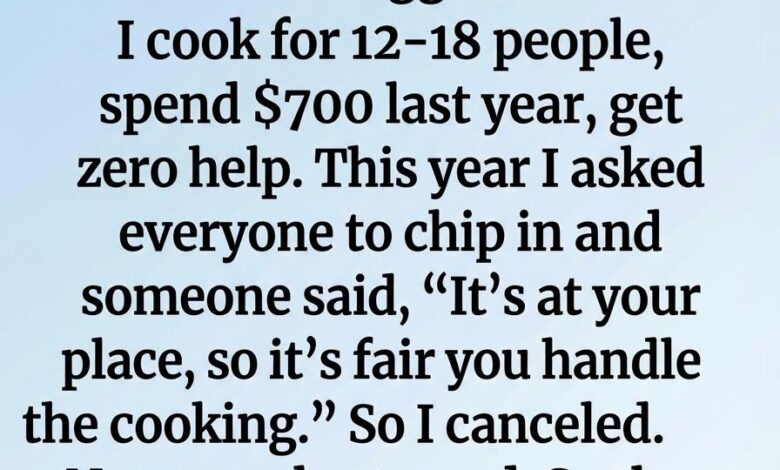
However, the reality behind the scenes was far less picturesque. While my guests were enjoying the warmth of the fire and the bounty of the spread, I was a ghost in my own home, tethered to the kitchen and the sink. Last year’s celebration felt like the final straw. I spent hundreds of dollars on a prime rib roast, organic sides, and fine wine, and devoted three full days to preparation. Not a single person offered to help with the cost, and as the evening wound down, I stood alone at the dishwasher for two hours while everyone else relaxed in the living room, eventually leaving with tupperware containers full of the leftovers I had paid for and prepared. By the time I sat down at midnight, I didn’t feel festive; I felt exploited.
As the holidays approached this year, I felt a shift in my internal weather. I realized that I wasn’t actually upset about the act of hosting itself—I genuinely enjoy hospitality. What I was tired of was the invisibility of the effort. I was tired of carrying the weight of an entire family’s traditions on my back without a single hand reaching out to steady the load. I decided that this year, the arrangement needed to evolve into something more equitable.
I sent out a message to the group chat in early November. My tone was gentle but clear: I expressed how much I loved seeing everyone, but I admitted that the logistics were becoming too much for one person to handle. I proposed a collaborative approach—a true potluck where everyone brought a signature dish, or perhaps a shared fund to cover the soaring cost of groceries. I even suggested that a few people come over an hour early to help me with the final prep.
The response was a deafening, uncomfortable silence. When the replies finally trickled in, they weren’t offers of support; they were excuses. The pinnacle of the tension came during a phone call with a sibling who voiced the collective sentiment: “Well, since the gathering is at your house, it’s only fair that you handle the cooking. That’s just how it’s always been.”
The casualness of that statement was a revelation. It confirmed that my family didn’t see me as a host; they saw me as a service provider. The “tradition” they were so fond of wasn’t the gathering itself, but the luxury of being catered to without any personal sacrifice. In that moment, the invisible effort I had been exerting for years suddenly became painfully visible to me, and I realized that by never asking for help, I had trained them to believe I didn’t need any.
After a few days of quiet reflection, I made the most difficult decision of my adult life. I sent a follow-up message informing everyone that I would not be hosting Christmas this year. I explained that I needed a year of rest and suggested that if anyone else wanted to take the reins, I would be more than happy to show up with a side dish and a bottle of wine.
I expected a flurry of activity—perhaps a panicked realization that would lead to someone else stepping up or a sincere apology and a renewed offer to help me. Instead, there was a void. No one volunteered their home. No one suggested a restaurant. No one proposed a modified plan. Without my total, uncompensated labor as the engine, the family holiday gathering simply ceased to exist.
At first, the guilt was a heavy, suffocating blanket. I felt like the villain of the story, the person who had single-handedly “ruined” Christmas for the children and the elders. I worried that I was being petty or that I was throwing away something precious over a few hours of dishwashing. But as the days passed and the usual December frenzy failed to materialize, a different feeling began to emerge: a profound, crystalline sense of relief. For the first time in a decade, my heart rate didn’t spike when I saw a commercial for holiday hams.
When Christmas Day finally arrived, the house was silent, but it wasn’t lonely. There was no mountain of coats on the bed, no frantic checking of the oven timer, and no forced small talk over a table that felt too small for the egos around it. I made a simple, high-quality meal for one—just the things I liked. I lit a beeswax candle, put on a record I hadn’t listened to in years, and allowed the hours to unfold with a luxurious lack of purpose.
I spent the afternoon reflecting on what this silence actually meant. I realized that a tradition that collapses the moment one person stops overextending themselves isn’t a tradition at all; it’s an obligation. True family traditions are supposed to be built on mutual care and reciprocal effort. If the only thing holding us together was my willingness to be a martyr, then what we had wasn’t a community—it was a convenience.
Stepping back wasn’t an act of selfishness; it was a necessary act of self-preservation. It was a declaration that my time, my finances, and my peace of mind have value. By setting that boundary, I wasn’t destroying a holiday; I was reclaiming my right to enjoy it. I learned that “no” is a complete sentence and that being the “strong one” or the “provider” often just means you’re the one whose needs are the easiest to ignore.
As I sat by the window watching the snow fall, I didn’t miss the chaos. I felt a deep, settled peace. I knew that in the future, if we gathered again, it would have to be on new terms. I would no longer accept a seat at a table where I was expected to do all the work while everyone else feasted. This year taught me that sometimes, letting go of what is expected of you makes space for something much healthier, even if it’s a little quieter. I didn’t ruin Christmas; I saved myself, and in doing so, I found the most honest holiday I’ve ever had.