Dramatic weight loss can wreak havoc on areas of the body prone to sagging
The advent of weight loss drugs on the mass market have offered a lifeline for many of us unhappy with our waistlines - but there's a new physical side-effect that's very hard to run from, say doctors.
When the fat melts away - as drugs such as Ozempic and Mounjaro work their magic by suppressing appetite, those who take them exalt that the benefits are as plentiful as the food they once devoured.
There's the raft of health pros - slimmed down souls rave about better sleep, improved mental wellness and the decreased risk of developing serious conditions such as heart disease and diabetes.
However, others will readily admit that the motivation for spending up to £250-a-month on weight loss jabs is purely vacuous - fired by the quest to look better and feel sexier.
And that's where the latest Ozempic side-effect to emerge is particularly hard to swallow.
'Ozempic neck' - a twist on the traditional 'turkey neck', which has long been associated with the ageing process and takes its name from the crepe-like red wattle on real-life turkeys - is firmly on the rise, say experts.
It's a weight loss jab side-effect that no moisturiser in the land can remedy, with surgery or more intense aesthetic treatments often the only option.
Former X Factor judge Sharon Osbourne, 73, admitted that taking Ozempic left her looking physically 'too gaunt'.
In November 2024, the wife of late rocker Ozzy, told Howie Mandel's podcast, she was 'frustrated' by what the drugs had done to her physique.

Sharon Osbourne pictured in 2024; the former X-Factor judge, 73, has been frank about how her use of weight loss drugs had left her 'too gaunt', as experts say

The much loved wife of late rocker Ozzy Osbourne pictured just two years earlier in 2022; Aesthetic doctor, Dr Emma Goulding, says 'when fat is lost quickly, especially in midlife and beyond, the skin often can¿t bounce back as smoothly'
The 73-year-old said: 'I can't put on weight now, and I don't know what it's done to my metabolism, but I just can't seem to put any on, because I think I went too far.'
'Ozempic neck' finds itself added to a growing list of terms that describe the often irreversible - if you remain slim - consequences of being half the person you once were.
There's already 'Ozempic feet', referring to sagging or aging skin on the feet due to rapid fat loss - 'Ozempic face' and 'Ozempic butt', both caused by dramatic reductions in body fat.
Ozempic and other alternatives like Mounjaro and Wegovy are all different brand names for the drug semaglutide that mimics the the actions of GLP-1 - a hormone in the brain that regulates appetite and feelings of fullness.
Weekly doses of these blockbuster weight loss medicines can help people shed 15 to 20 per cent of their body weight on average.
While the physical side effects while taking such drugs have been well documented - ranging from nausea to bloating and constipation, there's an increasing school of thought that such rapid weight-loss will definitely take off the pounds - but it can also pile on the years.


Like the face, the neck is one of the most visible parts of the human body, and is amongst the first place that ageing is obvious.
Why is the nape and under the jaw so vulnerable to being negatively transformed by weight-loss?
Aesthetic doctor, Dr Emma Goulding, who runs her own clinic in Cheshire, explains, telling the Daily Mail: 'The neck has much thinner skin, less oil production and less underlying support than the face, so when fat is lost quickly, especially in midlife and beyond, the skin often can’t bounce back as smoothly.
Ozempic neck is really the skin reacting to rapid weight loss combined with age, which causes reduced elasticity.
'That’s when fine lines, creasing and laxity start to show.'
Which other celebrities have struggled with the cosmetic downsides?
Robbie Williams revealed he lost 25lbs - nearly 2 stone - using weight-loss drugs but some fans were left concerned by the Take That star's 'skinny' appearance in his 2023 Netflix series.
While Ozempic neck is much more likely in older patients, some cosmetic doctors say they're also seeing requests to remedy sagging neck skin in much younger patients.
Consultant plastic surgeon Mr Paul Tulley says a 'growing number of patients in their 20s and 30s are becoming increasingly concerned about the appearance of their neck.'


Many now view early treatment as a preventative approach rather than waiting until signs become more pronounced. The openness of celebrities and influencers discussing their own treatments has helped remove a lot of the previous stigma.'
For some, if it's been a major amount of weight lost, their neck is likely to look different to the way it has for their entire adult life.
Says Dr Victoria Manning, Cosmetic Doctor at The Cosmetic Skin Clinic: 'What’s particularly interesting is that many people are discovering they actually have necks – not just “fnecks” where the face morphs directly into the neck.
'When you lose significant weight, suddenly there’s definition where there wasn’t before, but along with that comes loose, crepey skin that people weren’t prepared for.
'The neck has become one of the most challenging areas to treat because the skin there is so delicate and prone to laxity.'
So, if surgery or cosmetic 'tweakments' are the only way to rid yourself of 'Ozempic neck', where should you begin?
Dr Emma Goulding says: 'The good news is that treatments which stimulate collagen, such as radiofrequency, ultrasound skin tightening and injectable bio stimulators, can significantly improve firmness and texture.
'The best results tend to come from starting early and taking a gradual, medically guided approach.'
The aesthetic treatment that helped me banish 'Turkey neck' after taking Ozempic
Beauty Editor Olivia Falcon, writing for You Magazine reveals how she combatted 'Ozempic neck' after she developed sagging skin after losing 10kg on the drug...

While people talk about Ozempic face, I found slack skin on my neck to be worse after weight loss.
I went to nurse practitioner Alexandra Mills (amaesthetics.clinic) to try Revitalis (£250), a new injectable skin booster containing hyaluronic acid and glycerol that helps to smooth crepey skin with a pleasing plumping effect.
For the best results you need three sessions paced two to four weeks apart. The effects last about six months.
To tighten and strengthen the delicate skin in the area, I followed this up with a visit to Dr Paris Acharya (drparis.co.uk), who has developed a three-step Nécolleté treatment costing £850.
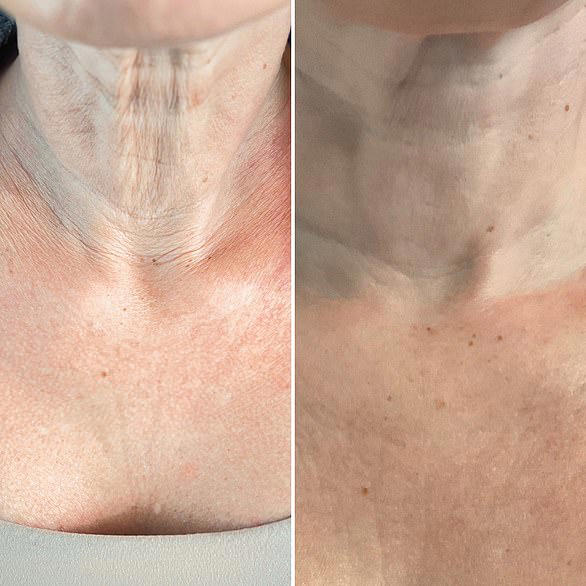
It starts with NCTF (new cellular treatment factor) mesotherapy: tiny, pretty painless injections of more than 50 vitamins and minerals to boost skin health.
Next Dr Paris administers a Radiesse ‘wash’ solution made of calcium hydroxylapatite (a mineral found in bone that acts like scaffolding under wrinkly skin), using a cannula to delicately distribute the fluids.
As a final flourish, she injected tiny dots of Plinest polynucleotides (highly purified salmon DNA) that work to produce more collagen.
I had two Nécolleté treatments spaced six weeks apart and despite some initial bruising around my neck, the before and after pictures above speak for themselves: the effects are remarkable and should last up to 18 months.
Is prevention better than cure?
It's not quite as straightforward as that, explains Dr Ed Robinson, who runs a Harley Street aesthetic clinic, but he advises there are definitely steps you can take while your weight-loss journey is happening.
He tells the Daily Mail: 'Aim for slower, steadier change where appropriate. If weight loss is very rapid, skin contraction often lags behind. A slower trajectory can sometimes be kinder to the neck.'
Dr Robinson says having a conversation with whoever's prescribing your weight loss drugs about how often you take the drugs could help.
'And consider your lifestyle factors, prioritising dietary proteins as this supports lean mass and skin building blocks.
'Resistance training also helps to preserve muscle mass, which reduces the "deflated" look overall. Make sure to apply daily SPF 50 on the neck - most people miss this area!'