The clock on the wall of the Huntsville Unit showed 6:00 a.m., and Daniel Foster had stopped counting the days.
He’d been counting them for five years—five years of concrete walls, five years of staring at the ceiling during sleepless nights, five years of screaming his innocence into an indifferent void. The Texas heat pressed against the windows of his cell like it was trying to crush him from the outside, the same way the justice system had crushed him from within. Today, all that counting would stop.
In exactly twelve hours, Daniel Foster would be executed by lethal injection for a crime he didn’t commit.
He sat on the edge of his prison bunk, wearing the orange jumpsuit that had become his entire identity, and tried to think of his daughter. Emily would be eight years old now. He hadn’t held her since she was three—hadn’t seen her face in person since the trial, when she’d sat in the gallery with her grandmother, too young to understand why her father was sitting at a table with people who wanted him dead.
The guards came to his cell around sunrise, their footsteps echoing down the tier in that way that made other inmates go quiet. Everyone knew what this meant. They’d seen it before.
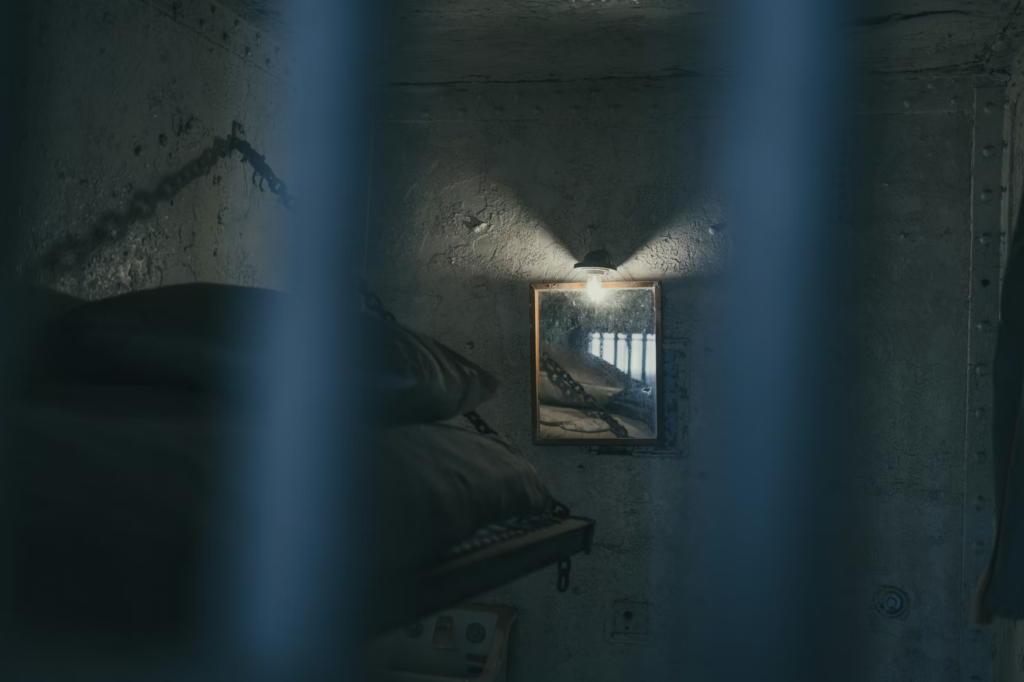
Daniel stood without resistance. He had stopped fighting long ago.
“Is there anything you need?” one of the guards asked—a younger man named Torres, who seemed genuinely troubled by what was about to happen.
Daniel thought for a moment. He’d been given the standard last meal request form weeks ago, but he’d never filled it out. What was the point of eating when you were about to die?
“I want to see my daughter,” he said, his voice hoarse from disuse. “Just once. Please. Before it’s over. Let me see Emily.”
Torres looked at him with something that might have been sympathy, then exchanged a glance with the older guard beside him—a veteran named Watkins who’d seen enough executions to have developed a kind of professional numbness about the whole thing.
“That’s not really how this works, Foster,” Watkins said, but not unkindly.
“I know,” Daniel replied. “But I’m asking anyway.”
The request traveled up the chain of command like a quiet prayer no one expected to be answered. It landed on the desk of Warden Robert Mitchell, a sixty-year-old man with silver hair and lines carved deep around his eyes from decades of witnessing state-sanctioned death.
Mitchell had overseen one hundred and forty-seven executions during his career at Huntsville. He’d gotten good at compartmentalizing—at moving through the mechanics of it without feeling the weight of it. But there was something about Daniel Foster’s case that had never quite settled right in his chest.
The evidence at trial had seemed airtight. Fingerprints on the murder weapon. Blood on Foster’s clothes. A neighbor who claimed to have seen him leaving the house that night. The prosecutor had presented it all with the kind of surgical precision that made conviction feel inevitable.
Yet in five years of brief conversations through a thick glass partition, Daniel Foster’s eyes had never looked like those of a killer. They looked like the eyes of a man telling the truth to people who had decided long ago not to listen.
Mitchell stared at the execution order on his desk. He thought about his own daughter, who was thirty-two now and lived in California and had made it clear she didn’t want to be part of his life anymore. He thought about what it would feel like to know you were about to die and have only one request: to see your child one more time.
He picked up the phone.
“Bring the child,” he said simply.
Three hours later, a white state vehicle pulled into the parking lot of the Huntsville Unit, and a social worker stepped out, holding the small hand of an eight-year-old girl with blonde hair that caught the Texas sunlight and pale blue eyes that had learned too early to be cautious.
Emily Foster had spent the last six months living in a state-operated children’s home. Before that, she’d bounced through a series of foster families, each one trying and ultimately failing to provide what a traumatized child needed. Her uncle Michael, her father’s younger brother, had made a brief appearance at the social services office two years ago, asking about guardianship, but then seemed to lose interest when he learned there was no inheritance attached to the arrangement.
Emily didn’t speak much anymore. The psychologists had given it a clinical name—selective mutism—which meant her mind had decided it was safer not to use her voice. But she drew.
She drew constantly.
Pictures of houses. Pictures of flowers. Pictures of dark shapes that the counselors couldn’t quite interpret but that made them frown and scribble notes in their files.
The social worker, a kind woman named Rachel who’d been working with Emily for four months, wasn’t sure what to expect from this visit. The child had shown no emotional response when told she would be seeing her father. No excitement. No fear. Just that characteristic blank acceptance that told Rachel this little girl had learned that life didn’t ask for her input anyway.
They walked through the prison corridor together, Rachel’s hand warm around Emily’s small fingers. Inmates fell silent as they passed—a phenomenon Rachel had seen before. Something about a child in a place designed for men convicted of terrible things seemed to activate some dormant conscience even in the most hardened inmates.
The visitation room was small and beige, with reinforced windows and a table bolted to the floor. Daniel was already there, shackled at both wrists and ankles, wearing the faded orange of death row. He looked smaller than Rachel expected, worn down by five years of waiting to die, his hair graying at the temples, his face mapped with the kind of exhaustion that comes from insomnia that never ends.
When he saw Emily, something happened to his face that made Rachel’s chest tighten.
“My baby girl…” he whispered, and his voice cracked like old wood. Tears began to stream down his face without him seeming to notice.
Emily didn’t run. She didn’t cry. She walked forward slowly, like someone approaching a memorial, and she wrapped her small arms around her father’s neck as much as the restraints would allow.
They held each other.
Rachel stepped back and turned toward the window, giving them privacy. She could see the guards through the glass, watching carefully, ready to intervene if anything went wrong. But nothing was going wrong. A man on death row was crying silently into his daughter’s hair, and a child who hadn’t spoken in months was finally allowing herself to touch another human being without fear.
For a full minute, they didn’t speak at all.
Then Emily leaned close to her father’s ear, close enough that the words were barely audible, certainly not audible to anyone but him.
Rachel couldn’t hear what the child whispered. None of the guards could either. But she saw Daniel’s entire body go rigid. She saw his face go pale, the color draining from it like someone had opened a drain valve.
He pulled back just enough to look at Emily, holding her at arm’s length, his shackled hands making the gesture awkward and heart-breaking.
“Are you sure?” he asked, his voice breaking on every syllable. “Emily, are you absolutely sure?”
Emily nodded once, firmly.
Daniel Foster let out a sound that wasn’t quite a laugh and wasn’t quite a sob. It was something in between—the sound of a man whose last thread of hope had suddenly been pulled taut.
He shot to his feet so suddenly that his chair crashed backward to the concrete floor with a bang that echoed through the room. The guards tensed immediately, moving forward.
“I’m innocent!” Daniel shouted, tears streaming freely down his face. “I can prove it now! I can prove it!”
The guards rushed in, their training activating, hands moving to restraints and defensive positions. But Daniel wasn’t fighting them. He was crying—sobbing with a desperation that felt fundamentally different from the hopelessness they’d all come to expect from death row inmates in their final hours.
“Get the warden!” Torres shouted. “Get Warden Mitchell, now!”
Rachel scooped Emily up in her arms, the child’s body rigid with shock. Emily’s eyes remained fixed on her father as the guards led him away, no longer looking blank. For the first time in months, she looked alive.
Warden Mitchell watched the entire scene from the security monitor in his office, the image frozen on his screen: an eight-year-old girl’s face, solemn and certain.
He sat in silence for several minutes, his fingers steepled in front of his mouth, a habit he’d developed when faced with difficult decisions.
Then he reached for his phone and called the Texas Attorney General’s office.
“This is Warden Robert Mitchell at the Huntsville Unit,” he said, his voice steady but carrying the weight of what he was about to do. “I need to request a 72-hour stay of execution for Daniel Foster.”
The voice on the other end was sharp with surprise and frustration.
“On what grounds? The appeals process is exhausted, Warden. We’re forty-eight minutes from the final protocols.”
Mitchell closed his eyes.
“New evidence,” he said quietly. “A witness. A child. And I believe we may have convicted the wrong man.”
Two hundred miles away, in a quiet suburb of Dallas where oak trees draped their branches over wide streets and houses sat back from the road like secrets, a retired defense attorney named Margaret Hayes, sixty-eight years old and supposedly living out her final years in peaceful obscurity, nearly choked on her morning coffee.

She’d been scrolling through her phone on the back patio of her modest home, sipping from a mug that said “World’s Okayest Lawyer” (a gift from one of her grandchildren), when the news alert popped up: EXECUTION HALTED IN FOSTER CASE. NEW EVIDENCE SUGGESTS POSSIBLE INNOCENCE.
Margaret had been practicing law for forty-two years before retirement. She’d won more cases than she could count and lost more than she wanted to remember. But there was one case that had never stopped haunting her—one she’d taken right out of law school, representing a man she believed was innocent, and she’d failed him. Her inexperience, her mistakes in strategy, her failure to see the full picture until it was too late—all of it had contributed to a wrongful conviction.
She’d promised herself then that if she ever got a second chance, she would see the whole board this time.
When she saw Daniel Foster’s face on the television—the same face she’d defended thirty years ago (because it turned out she’d represented his uncle, Michael, on a minor charge way back when)—something in her gut tightened.
Margaret set down her coffee and went inside to get her laptop.
Within an hour, she had the trial transcripts pulled up, the news articles archived, the prosecutor’s summary reviewed. Judge Alan Brooks. Conviction based on forensic evidence. No mention of any other suspects. The crime scene: a house on Elderberry Lane in suburban Dallas where Laura Foster, Daniel’s wife, had been found dead. Blunt force trauma. Murder weapon recovered in the garage.
Daniel’s fingerprints. Daniel’s blood on his clothes.
It had seemed airtight at the time.
But Margaret was good at finding the threads that pulled airtight cases apart. It took her three hours of cross-referencing to find the first one: Judge Alan Brooks had presided over her case defending Michael Foster twenty-eight years ago—a shoplifting charge that had been dropped. But that wasn’t the interesting part. The interesting part was that Alan Brooks and Michael Foster had personal business ties.
Margaret found it buried in a financial records database: Brooks and Foster had been investors together in a commercial real estate development firm that had gone belly-up in 2006. The investments had been made in the names of wives and shell companies, the kind of financial maneuvering that suggested people trying to hide something.
She dug deeper.
Laura Foster had been a paralegal. Smart woman. Margaret found her name in a few court records, working alongside attorneys on various cases. And then, in the weeks leading up to her death, Laura had apparently been researching financial documents and legal records—the kind of research a paralegal would know how to conduct thoroughly.
What if Laura had discovered something?
What if Laura had found evidence of corruption?
Margaret called an old friend at the Texas Bar Association and requested information about Judge Alan Brooks. What she learned made her blood run cold: there had been complaints about Brooks over the years. Accusations of bias in cases involving certain defendants. Suggestions of impropriety. Nothing that stuck, nothing that rose to the level of official sanction, but enough that Margaret’s retired attorney’s instincts began firing on all cylinders.
She made a decision that would change everything.
Margaret picked up her phone and called the Huntsville Unit.
“This is Margaret Hayes,” she told the woman who answered. “I’m a retired attorney, and I need to file an emergency motion in the Daniel Foster case. I believe there’s been a serious miscarriage of justice, and I have evidence to support it.”
Meanwhile, in the state children’s home where Emily Foster had been living, the girl’s therapist, Dr. Patricia Nguyen, was reviewing the artwork Emily had been creating for the past six months.
Emily had never spoken to Dr. Nguyen. The girl had sat in her office seventeen times and produced sixty-three drawings but had never said a single word. Yet the drawings told a story that the clinical assessment forms couldn’t quite capture.
Most of the recent drawings were variations on the same theme: a house. Inside the house, a figure on the floor—usually drawn in red or dark purple. A taller figure standing over that person, often wearing what looked like a blue shirt. And in most of the drawings, a small figure hiding in a corner or peeking around a doorway.
“I wonder what this means,” Dr. Nguyen had written in her notes six months ago, when the drawings first began.
But now, with the news of Daniel Foster’s execution being halted, with whispers traveling through the social services network about possible wrongful conviction, Dr. Nguyen pulled out Emily’s file and looked at the drawings with new eyes.
The man in the blue shirt.
Daniel had been described in trial transcripts as wearing a dark hoodie. His work clothes, according to the evidence logs, were mostly t-shirts and jeans.
Dr. Nguyen had seen photos of Michael Foster in the case file—a brief mention of him as Emily’s uncle. And in every photo she could find, Michael Foster was wearing a blue shirt.
She immediately contacted Margaret Hayes.
“I have a child patient,” Dr. Nguyen said carefully, aware of privacy laws but also aware of something more important than privacy laws. “Who has been drawing pictures that might be relevant to the Daniel Foster case. With parental—or in this case, guardianship—permission, I believe these images should be examined.”
“Who has guardianship?” Margaret asked, already suspecting the answer.
“His brother, Michael Foster,” Dr. Nguyen said.
The phone line went quiet for a long moment.
“Don’t send those drawings through official channels,” Margaret said finally. “At least not yet. Send them to me. Directly. And send them digitally, with a timestamp and your signature authenticating them. We need to keep this tight until we understand what we’re dealing with.”
With less than thirty hours remaining on the execution clock that had now been stopped but not reversed, Margaret’s phone rang. The caller ID showed a number she didn’t recognize, but the voice that came through was urgent and haunted by five years of silence.
“My name is Ethan Reyes,” the man said. “I was the landscaper for the Foster family. I’ve been in hiding for five years, but I saw what happened that night. And I need to tell someone before Daniel dies for something his brother did.”
Ethan Reyes had been twenty-three years old when he witnessed the attack on Laura Foster. He’d been there to trim the hedges, had been working in the backyard, when he heard shouting coming from inside the house. He’d been young and brave and stupid, so he’d gone inside to see if he could help.
What he found stopped his heart.
Michael Foster was standing over his sister-in-law with a lamp base raised over his head. Laura was on the ground, bleeding, gasping, one arm raised to protect her face. And in the hallway, just out of Michael’s line of sight, seven-year-old Emily was peeking around the corner, frozen in terror.
“Stop!” Ethan had shouted, and somehow—miraculously—Michael had hesitated. That hesitation was the only reason Laura was still alive.
What Ethan hadn’t known then was that Michael had a backup plan. He’d already contacted someone. He’d already arranged for someone to clean up the mess.
Judge Alan Brooks had a son who had problems. Bad problems. Problems that required people to disappear, to forget things, to suddenly become unavailable to testify. Michael Foster had leverage on both sides of the justice system, connections Margaret would later discover had been built through that shared real estate investment and through darker favors still.
Michael had called Brooks immediately after the attack, bleeding from where Laura had scratched him, panicking. Brooks had told him what to do with chilling precision.
“Get your brother there,” Brooks had said. “Tonight. Make sure people see him. Make sure evidence gets found.”
And Michael had done exactly that. He’d called Daniel at work, frantic, begging him to come home immediately. Daniel, who loved his brother and trusted him, had come home to find his wife brutalized and his life about to collapse.
By the time Daniel arrived, Ethan had already gotten Laura out. He’d bundled her into his landscaping truck, driven her to a hospital three towns over, checked her in under a false name, and then fled. He’d been frightened and young and certain that if he stayed, he’d be killed. So he’d disappeared, driving north, changing his identity, living in a haze of guilt for five years.
But he’d kept the hospital records. He’d kept the receipt from the gas station where he’d stopped on the drive. He’d kept a diary of everything that happened, locked away in a safe deposit box.
And he had recordings.
“I went back,” Ethan told Margaret over the phone. “Three days after it happened. I had a recorder in my truck—I was doing security checks for some clients. I drove by Michael’s house, and I left the truck running with the recorder on, parked in the driveway. I told him I’d changed my mind about helping, that I needed to know exactly what happened.”
“That’s insane,” Margaret breathed. “That’s crazy, and it’s probably inadmissible, and it’s also incredibly brave.”
“Listen to it first,” Ethan said. “And then you decide if it’s admissible.”
Margaret listened.
What she heard made her hands shake. Michael Foster, talking to someone on the phone—and later Margaret would discover that someone was Judge Alan Brooks—discussing how to “handle” Daniel. How to make sure he took the fall. How to make sure no one would ever look too closely at the forensic evidence because it would point to the right suspect eventually, and who wanted to be known as the prosecutor who’d made that mistake?
“She’s not dead, by the way,” she heard Michael say at one point. “The landscaper got her out. But she’s too weak to testify, and she won’t survive if we put the pressure on her. So as far as the world knows, we’re mourning her. And Daniel’s going to die for it.”
There was laughter on the recording. Actual laughter.
That was the moment Margaret Hayes, sixty-eight-year-old retired attorney, felt something inside her crystallize into pure, cold determination.
She called the safe house where Dr. Nguyen had helped relocate Laura Foster—a place Emily had never been told about, where her mother had spent five years slowly healing from injuries both physical and psychological.
“I think it’s time,” Margaret said. “I think it’s time to bring her back.”

Laura Foster had been forty-three years old when she’d been beaten nearly to death. She was forty-eight now, and she looked older than that—the weight of five years of hiding had carved itself into her face in ways that sunlight and safety couldn’t quite erase.
When Margaret met her for the first time, in a safe house outside San Antonio, they sat across from each other at a kitchen table, and Margaret saw the woman who had inspired all of this: the paralegal who’d been smart enough to notice corruption, brave enough to investigate it, and unlucky enough to cross the path of dangerous men.
“Your daughter knows,” Margaret said. “She knows you’re alive. She told her father, and that’s what started this whole thing unraveling.”
Laura began to weep—not the delicate tears of someone who’s been crying regularly, but the harsh, gasping sobs of someone who has held their grief in suspension for five years.
“I wanted to tell her so many times,” she whispered. “But they said if I did, if I tried to contact her, they would kill us both. That Michael had connections. That Judge Brooks had connections.”
“They were right,” Margaret said bluntly. “And they might still try. But now we have something they didn’t count on: evidence. Audio recordings. Hospital records under a false name that we can authenticate. Your testimony. And your daughter’s drawings—which clearly show what actually happened that night.”
Within twenty-four hours, Margaret had filed an emergency motion before the Texas Supreme Court. It was a document that had taken her six decades of legal experience to craft—precise, devastating, and absolutely iron-clad.
The evidence it presented included:
The audio recordings of Michael Foster discussing the murder with Judge Alan Brooks.
Hospital records from Mercy General Medical Center that showed a patient matching Laura Foster’s description had been admitted three days after the alleged murder with injuries consistent with the attack described in trial testimony.
Emily Foster’s drawings, authenticated by a licensed psychologist, which accurately depicted the crime scene and the perpetrator’s clothing in a manner a seven-year-old could not have known unless she’d witnessed it.
Testimony from Ethan Reyes, who provided contemporaneous documentation of his involvement in removing Laura from the scene.
Financial records showing improper connections between Michael Foster and Judge Alan Brooks dating back nearly three decades.
And most damning of all: a video deposition of Laura Foster, recorded at the safe house, in which she described the attack in detail and identified her attacker as her brother-in-law, Michael Foster.
The Texas Supreme Court, faced with evidence of such egregious corruption and such undeniable innocence, had no choice.
The execution was halted indefinitely. All charges against Daniel Foster were vacated. New arrests were issued for Michael Foster and Judge Alan Brooks.
Back in Huntsville, Daniel Foster slept in his cell that night for the first time in five years without knowing whether he would wake up to death.
He woke up to freedom instead.
The press conferences that followed were the kind that career prosecutors and judges dread—the kind where the machinery of justice is revealed to have been operated by corrupt hands.
Michael Foster pleaded guilty to attempted murder and conspiracy in exchange for a reduced sentence. Judge Alan Brooks fought it longer, but the evidence was too overwhelming. He resigned from the bench and was later convicted on multiple corruption charges.
Daniel Foster walked out of the Huntsville Unit on a Tuesday morning into bright Texas sunshine, and the first person he saw was his daughter.
Emily ran to him.
They held each other, and neither of them cried. They had already done all their crying.
“I knew you didn’t do it,” Emily said, finally using her voice. “I always knew. I just couldn’t tell anyone.”
“I know, baby,” Daniel said. “And I always knew you would find the way to tell them. Somehow, I always knew.”
Laura appeared from behind a support column, and when Daniel saw her, the look on his face was the kind of look people write poems about—a man seeing his wife returned from the dead, his daughter returned from trauma, his life returned from the abyss.
They stood together as a family, really stood together, for the first time in five years.
Margaret Hayes watched from a distance, having decided she was done retiring. She was going to spend her final years working on cases like this one—cases where the machinery of justice had broken down, where innocent people had fallen through the cracks, where a child’s whisper could break open the entire corrupt structure.
“Sometimes justice doesn’t roar,” she said to a reporter who asked her to comment on the case. “Sometimes it whispers. You just have to be willing to listen.”
The Silent Language of a Child’s Truth
What Dr. Patricia Nguyen understood, sitting with those drawings spread out before her, was that children speak the truth in the ways they’re allowed to speak. Emily Foster had been silenced—by trauma, by fear, by adults who didn’t believe her. So she’d drawn her testimony in red crayon and purple marker, in careful lines and careful shapes.
The blue shirt had been the key. Daniel Foster had worn dark colors that night. But Michael Foster always wore blue.
Emily’s subconscious had documented it perfectly.
Why Systems Fail and How One Person Fought Back
The case of Daniel Foster exposed something the Texas justice system had been trying to hide: corruption at multiple levels, from the detective who’d gathered evidence with tunnel vision, to the prosecutor who’d moved forward despite inconsistencies, to the judge who’d allowed personal business interests to influence judicial decisions.
Margaret Hayes filed suit against the Texas Department of Criminal Justice for wrongful incarceration. Daniel Foster received a settlement, though no amount of money could truly compensate for five years stolen from his life and three years stolen from his daughter’s childhood.
Judge Alan Brooks’ entire judicial record was examined. Forty-seven previous cases were reviewed. Twelve convictions were overturned. Four people were released from prison based on evidence that Brooks had ignored or manipulated.
Michael Foster, serving twenty years, would eventually die in prison. Some said it was fitting. Others said it wasn’t nearly justice enough.
Where They Are Now
Daniel Foster went back to the work he’d done before—HVAC repair. He’d learned the trade before he’d married Laura, and it was something his hands remembered even if his mind had been fractured by five years on death row.
He and Laura remarried, quietly, at a courthouse in Austin. No big ceremony. Just the two of them, their daughter, and Margaret Hayes as witness.
Emily went to school. She talked. She laughed. She drew pictures that weren’t about trauma—pictures of mountains and flowers and puppies. Normal things. A child’s things.
She wanted to be a lawyer, she told people, so she could help other children find their voices.
Margaret Hayes lived to see her eighty-first birthday and spent those years working on death row cases, on wrongful conviction cases, on cases where the machinery of justice had broken down. She helped sixteen more people escape execution. She helped thirty-three more people overturn convictions.
And she kept Emily Foster’s drawings framed in her office—not as trophies, but as reminders that the truth finds a way out, even when systems try to bury it.
Sometimes through whispers.
Sometimes through the careful hand of a child with a crayon, drawing what she couldn’t yet say.
What do you think about Daniel’s story and the incredible whisper that changed everything? We’d love to hear your thoughts in the comments below or come share your reaction on our Facebook page. If this story moved you—if it reminded you that truth has a way of coming to light—please share it with friends and family. These are the stories we need to tell, the ones that remind us to listen more carefully to the voices around us, especially the quiet ones.