My Son Disappeared Two Years Ago During A Winter Getaway, And I’d Lost Everything Searching For Answers. I Was Isolated In My Mountain Cabin When My Estranged Sister Pulled Up In A Lamborghini And Whispered, “Get In. I Know What Really Happened To Daniel.”
Part 1
Two winters ago, my son disappeared and took my life with him.
It happened during what was supposed to be a reset. A “fresh start” trip. The kind of getaway you book when your calendar is packed and your nerves are shot and you convince yourself that a few days in the mountains will fix whatever is quietly breaking inside you.
Daniel was ten then—skinny legs, quick smile, the kind of kid who asked a thousand questions and made you feel like the world was still worth studying. We rented a cabin by a frozen lake. We roasted marshmallows. We played cards. He begged to go outside after dinner because the snow was falling in thick, perfect sheets and the porch light made it look like glitter.
I said yes because I was tired and because I could see his excitement like a candle in his eyes.
He went out with his boots and his blue knit hat and a flashlight I handed him myself.
And then he was gone.
The search that followed cracked open the town like an egg. Sheriff’s deputies, volunteers, snowmobiles, dogs. Helicopters thudding overhead. Flashlights sweeping the treeline like interrogators. The lake was dragged. The trails were combed. The whole place smelled like fuel and panic.
They never found him.
No coat. No hat. No footprints leading anywhere that made sense.
The first week, I didn’t sleep. The second week, I forgot how to eat. By the third week, I stopped responding to anyone who tried to tell me the same soft lie in different packaging.
He’s probably—
No.
He is.
I left my job first. I’d been a forensic auditor attached to federal investigations—good at patterns, good at math, good at seeing what people hid behind numbers. My supervisor asked me to take leave, offered counseling, spoke in careful phrases like he was walking around broken glass.
I told him I couldn’t sit behind a desk while my son was missing.
Then I sold my house. People called it grief. I called it clearing space.
And then I drove deeper into the mountains than anyone thought was reasonable and moved into a small cabin with thin windows and a woodstove that hissed like a living thing. I pinned maps to the walls. I marked trails. I tracked tips. I reread reports until the paper softened at the folds. I listened to radio scanners like they were bedtime stories.
If you want to know what two years of waiting does to a person, it makes you quiet in a way that scares even you. It strips you down to one purpose until everything else feels like a costume.
Seven hundred and thirty days after Daniel vanished, I was still there. Still living in oversized sweaters and sweatpants. Still drinking black coffee because sugar felt like an insult to reality. Still waking up in the night because my brain kept replaying the moment I said, “Go ahead, baby,” as if the right angle of memory could change what happened.
The cabin was silent that morning, the kind of silence you can hear in your teeth.
Then an engine roared through the woods.
Not a truck. Not a snowmobile. Something loud and expensive, cutting through the blizzard like it had a point to prove.
I stepped to the window and saw a bright yellow SUV easing up my long, icy drive, headlights blazing through the swirling white. A Lamborghini. In my driveway. Like someone had dropped a neon warning sign into my grief.
The driver’s door opened and my sister climbed out.
Vanessa.
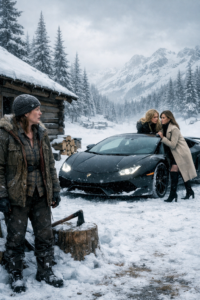
We hadn’t spoken in almost three years. Not since the funeral for my father, when she’d shown up late, dressed like she was attending a gala instead of burying a man, and told me I was “wasting my life” by choosing work over marriage and status. Vanessa collected rich people like some women collected handbags. She married money and called it love. She learned to smile while someone else wrote the rules.
She didn’t knock.
She shoved my door open like she owned the air, stomping snow off designer boots onto my warped wood floor. Her coat was custom, her hair flawless, her face cold with impatience.
She walked straight to my table and threw down a thick folder that landed with a heavy slap.
It wasn’t a normal folder. The corner was stained dark red, dried and ugly.
For a second, my stomach dropped so hard I tasted bile.
Vanessa didn’t offer a hug. She didn’t ask if I’d eaten or slept or survived.
She pointed at the folder like a prosecutor.
“Sign it,” she said. “Right now.”
I didn’t move. “What is this?”
“Your inheritance rights,” she snapped. “Grandma Evelyn’s house. Her estate. You sign away your claim, and I’ll tell you what happened to Daniel.”
The words hit me like a punch that didn’t bruise the skin—only the inside.
I stared at her, waiting for the part where she laughed and admitted it was a cruel misunderstanding.
She didn’t laugh.
I’d spent two years with my grief, and grief teaches you something people don’t talk about: rage isn’t the loudest emotion. Sometimes it’s the calmest.
“You drove up here in a blizzard,” I said slowly, “to trade property for my child?”
Vanessa rolled her eyes like I was being dramatic. “Don’t make this harder than it needs to be. Mom’s tired of your… performance. Preston’s tired of it. I’m tired of it.”
She said Preston’s name like it carried authority in my cabin.
Preston Vance—her husband. Hedge fund. Private jets. A smile that never reached his eyes. The kind of man who treated people like a balance sheet.
Vanessa tapped the folder with a manicured nail. “The trust only clears to me and Preston if Daniel is officially out of the picture. Your refusal to declare him dead is holding up everything.”
Out of the picture.
Like my son was a blurry inconvenience.
My fingers curled at my sides. I forced them to relax.
“Tell me about the blood,” I said, nodding toward the stain.
Vanessa’s mouth twitched. “Just sign.”
I watched her carefully, the way I used to watch suspects in interview rooms. People lied with their mouths, but their bodies leaked truth.
Vanessa shifted her weight, impatient. Her boots left wet marks on my floor.
And that’s when I saw it.
Not the boots themselves, but what was stuck in them—deep in the tread, packed tight.
Red clay.
Not the dark, rocky earth from this mountain. Not the pale grit near the lake where Daniel vanished.
Red clay like the kind you find in a very specific pocket of Maryland—the kind that clings to manicured estates in wealthy wooded suburbs, where gates are tall and cameras are higher.
My pulse didn’t race. It sharpened.
Vanessa thought she’d come to break a grieving mother.
She didn’t realize I hadn’t been living in this cabin just to grieve.
I’d been waiting.
Waiting for them to slip.
Waiting for someone to show me where to aim.
I picked up the pen on my table. Vanessa leaned forward, greedy triumph flashing in her eyes.
I didn’t beg. I didn’t scream. I didn’t bargain.
I signed.
The moment the ink dried, Vanessa snatched the folder like it might vanish if she didn’t hold it tight.
Her phone rang. She answered without looking at me, put it on speaker like she wanted an audience.
Mom’s voice snapped through my cabin. “Is it done?”
“Yes,” Vanessa cooed. “She signed.”
A sigh of relief. Not relief for me. Relief for the family machine.
“Nia,” my mother said, sharp and tired, “you’ve disgraced us long enough. Stop this madness. Let Preston handle things. He’s done more than you deserve.”
I stared at the wall of maps behind Vanessa’s shoulder and felt something in me go cold and clean.
Vanessa ended the call, zipped her coat, and headed for the door.
I followed her out onto the porch, letting the wind whip my hair across my face.
“You promised,” I called, making my voice shake just enough. “Where is he, Vanessa? Please.”
Vanessa paused at the driver’s door, looked over her shoulder, and smiled like she was enjoying this.
“Oh, Nia,” she laughed, cruel and light. “Did you really think I had a clue? Your kid wandered off two years ago. He’s gone.”
She gestured at the folder on her passenger seat. “And the blood? Fake. Costume makeup. Ten bucks.”
She climbed in, slammed the door, and the Lamborghini growled to life.
I let myself drop to my knees in the snow, putting on the show she wanted.
She watched for a heartbeat, satisfied.
Then she drove away, taillights cutting through the blizzard until the woods swallowed her whole.
The second she disappeared, I stopped trembling.
I stood, brushed snow from my knees, and walked back inside.
On my phone, a red dot blinked on a secure tracking app, moving steadily down my mountain road.
Vanessa thought she’d just taken everything from me.
She didn’t know she’d just handed me the first real lead I’d had in two years.
Part 2
I didn’t pack much.
A coat. Gloves. A thermos of coffee. The folder she’d forced me to sign—because I wanted to see every clause, every name, every legal fingerprint left behind.
And the small tracker I’d slipped into the Lamborghini when she was distracted, hidden where she wouldn’t notice on a quick sweep. Not magic. Not cinematic. Just insurance—one more thread in a web I’d been weaving for seven hundred and thirty days.
The road down the mountain was a white tunnel of wind and ice. My old sedan rattled like it resented being dragged back into the world of money and lies. I kept one eye on the road and one on the red dot crawling across my screen.
It headed exactly where I thought it would.
Maryland.
Not the city. Not a hotel. Not a police station.
An estate.
Vanessa didn’t stop for food or rest like a normal person driving in a storm. She drove like someone desperate to report success.
I’d learned long ago that criminals didn’t celebrate privately if they could avoid it. They celebrated where their power could be witnessed.
I reached the suburbs just after dusk the next day. The kind of neighborhood where the trees were old and the houses were hidden behind them, where the streetlights were tasteful and dim, where the air smelled like money.
I parked several blocks away, on a side street where my beat-up car looked like a bad joke.
Through the trees, I could see the iron gates to Preston’s property standing open like a mouth. Valets in black coats moved in quick, efficient loops. A line of luxury vehicles crept up the drive—German sedans, glossy SUVs, something low and silver that looked like it had never touched a pothole.
A party.
Of course.
People like Preston loved Sunday nights. They loved gathering before markets opened, before decisions became official, before consequences had names. They smoked expensive cigars and shook hands and traded favors like chips.
I pulled my hood up and moved through the hedges, keeping low, keeping my breathing slow.
At the front door, I didn’t sneak.
I walked in like I belonged.
No one expects audacity from a woman in damp jeans and a faded sweater. They expect apology. They expect fear. They expect you to hesitate at the threshold and ask permission to exist.
I didn’t.
Inside, the house smelled like roasted meat and perfume and polished wood. A string quartet played softly near the foyer, the kind of music designed to make money feel elegant.
Waiters glided past with champagne and tiny plates.
And in the middle of it all, beneath a chandelier that looked like it cost more than my old salary, stood Preston Vance.
He was laughing with a circle of men who had the posture of power—relaxed shoulders, loose smiles, eyes that measured everything.
When I stepped down into the sunken living room, the chatter began to thin. Faces turned. People stared the way they stare at a spill—curious, disgusted, slightly afraid of getting it on themselves.
Preston’s smile vanished the moment he saw me. Not shock. Annoyance.
Like I was a fly that had made it past the screen.
He handed his wine to a waiter without looking and walked toward me with smooth, heavy confidence.
“Well,” he said, voice loud enough for the nearest guests to hear, “look who crawled down from the mountain.”
I stopped a few feet from him. “Hello, Preston.”
His eyes flicked over my clothes like he was tallying my worth. “I assume Vanessa made it to your little cabin,” he said. “And I assume you signed.”
“I did,” I said, equally loud. “Because she promised to tell me where my son is.”
A ripple moved through the nearest guests. People leaned in without seeming to.
Preston laughed once, sharp. “Nia,” he said, like my name was a punchline, “you really are committed to your delusions.”
“Delusions don’t clear credit card transactions,” I replied.
His smile faltered for half a breath.
I pulled my phone from my pocket and held it up, screen bright. “Last week,” I said, “your private offshore card was used in Zurich at a luxury toy store. Three thousand dollars. On my son’s birthday.”
The room went very still.
The quartet faltered, then kept playing like their bows could hold the world together.
Preston’s face tightened. “Absurd,” he said quickly. “That card was stolen.”
“A stolen card doesn’t stay active long enough to clear that kind of purchase,” I said, calm as a spreadsheet. “Not unless someone wanted it active.”
Preston’s eyes darted—toward the guests, toward the exit, toward anything that could restore control.
He leaned closer, lowering his voice. “You’re trespassing. You’re embarrassing yourself.”
“You’re embarrassing yourself,” I said quietly. “You’re just used to no one saying it.”
His jaw flexed.
“Security,” he snapped, without looking away from me.
Two men in dark suits moved toward us from the foyer, scanning me like I might explode.
Preston lifted his chin, reclaiming his stage. “Daniel is gone,” he said, louder now. “Everyone knows it except you.”
He was building a narrative in real time. He wanted an audience for my collapse.
“Then why did your wife drive up a mountain in a blizzard,” I asked, “to pressure me into declaring him dead?”
Preston’s smile hardened. “Because you’re holding up family business.”
“Family business,” I repeated, tasting the words. “Is that what you call kidnapping a child’s trust fund?”
The nearest guests exchanged glances.
That’s when the double doors to the dining room opened, and my mother walked out.
Not in grief. Not in concern.
In silk.
She was draped in emerald fabric and diamonds, hair perfect, posture straight as a ruler. Behind her trailed two of my aunts, faces tight with the strain of pretending they didn’t know what they knew.
My mother’s eyes locked onto mine, and in them I didn’t see relief.
I saw rage.
She marched straight up to me and slapped me across the face.
The crack echoed through the house like a gunshot.
My head snapped to the side. Heat bloomed on my cheek. The taste of blood filled my mouth where my teeth caught my lip.
“How dare you,” she hissed, loud enough for the guests to hear. “You walk into this man’s home looking like a beggar and accuse him in front of his colleagues?”
She turned to the guests with a desperate, practiced smile. “I’m so sorry,” she announced, voice sweetening. “My daughter has been unwell since the tragedy. She suffers delusions. Preston has been trying to help her.”
I stared at her, my cheek burning, and felt something inside me settle.
This wasn’t a misunderstanding.
This was an operation.
Preston’s shoulders eased as my mother did exactly what he needed—framed me as unstable, framed him as savior, framed the truth as madness.
The security guards moved closer, hands hovering near my arms.
I wiped the blood from my mouth with the back of my hand and looked at my mother.
“You’re defending him,” I said, voice low but carrying.
My mother’s smile twitched. “Nia,” she warned, eyes sharp, “stop.”
I took one slow step forward, forcing her to step back without meaning to.
“You want them to believe I’m delusional,” I said, raising my voice, letting it fill the room. “So explain something simple, Mom.”
Her eyes flickered.
“If Preston is a saint,” I continued, “why did his offshore holding company clear your five-hundred-thousand-dollar gambling debt last month?”
The house went silent so fast it felt like someone had sucked the air out.
My mother froze. My aunts stared at the floor like it had suddenly become interesting.
Preston’s smile vanished.
And somewhere behind him, I saw Vanessa appear at the edge of the room, still in her designer coat, boots still marked with that red clay.
Her face was pale.
She’d walked into the moment the lie started collapsing.
I didn’t wait for my mother to recover.
I looked at Preston and said, calm as a verdict, “Tell them what you did to my son.”
Part 3
For a moment, Preston didn’t move.
He stood there like a man who’d spent his whole life believing the rules would bend for him and was now realizing someone else might be holding the pen.
The guests closest to us—investors, politicians, executives—shifted like a school of fish sensing a shark. They weren’t loyal to Preston. They were loyal to their own survival.
My mother’s mouth opened and closed once, silent. Her face was still arranged in that polished, social smile, but her eyes were pleading.
Not pleading with me.
Pleading with Preston.
Fix it. Make it go away. Protect the image.
Vanessa pushed forward, voice sharp with panic. “Nia, stop,” she snapped, trying to sound in control. “You’re ruining everything.”
I turned my head slightly. “That’s the point.”
Preston recovered enough to sneer. “This is ridiculous,” he said, spreading his hands in a gesture meant to look reasonable. “She’s grieving. She’s unstable. She hacked into accounts—”
“A stolen card doesn’t clear a Zurich purchase,” I cut in. “A hacked account doesn’t explain why your wife tried to buy my signature with my son’s name.”
One of the older men near the fireplace—silver hair, the calm of someone used to being obeyed—leaned forward. “Preston,” he said, voice quiet but dangerous, “what is she talking about?”
Preston’s jaw tightened. “She’s lying,” he snapped.
I didn’t raise my voice. I didn’t need to.
I reached into my coat pocket and pulled out copies of financial records I’d been building for months. Not fantasies. Not guesses. Patterns. Transfers. Shell entities stacked like nesting dolls.
I tossed them onto the nearest marble table.
Paper fanned out. Numbers stared back at people who understood numbers better than they understood morality.
“This,” I said, tapping one page, “is a charity you created in Delaware. The Daniel Hope Foundation.”
A few guests flinched at the name, recognizing it from glossy mailers.
“You held private fundraisers,” I continued, “and told donors the money was for missing children. For my son.”
Vanessa’s breath hitched.
“But the funds didn’t go to searches,” I said. “They went through a shell company in the Bahamas and into your hedge fund accounts.”
A low murmur spread.
The silver-haired man’s eyes narrowed as he read. Another guest pulled out his phone, scrolling fast like he was already checking his exposure.
My mother grabbed my arm, nails digging into my skin. “Stop,” she hissed through clenched teeth. “You’re humiliating us.”