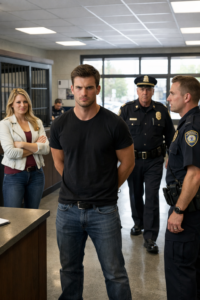
The Chief Of Police. He Walked Into The Station And Asked The Officer: “Would You Mind Explaining Why My Son Is In Handcuffs?”
Part 1
I’m a firefighter. My life is built around moving toward the thing everyone else is escaping.
When the pager goes off at three in the morning, you don’t get to be fragile. You don’t get to spiral. You pull on your boots, you check your gear, and you go. You trust the people beside you with the kind of trust that has weight. You learn discipline, because panic is contagious. You learn calm, because the world is always louder than you want it to be.
For a long time, I thought my relationship with Jessica ran on the same principles.
Jessica and I met at a charity 5K my department hosted. She wore a bright smile and an expensive watch and asked me questions like my answers mattered. She said she loved first responders. She said she admired men who served. She said the right things with the ease of someone who’d practiced them in a mirror.
I didn’t see the practice. I saw the warmth.
We moved fast. Too fast. She filled my small house with scented candles and throw pillows and little upgrades I never asked for. She talked about our future like it was already planned: wedding, bigger home, vacations, kids. When she said it, it sounded like a promise.
When she spent money, it sounded like confidence.
I’m not wealthy. I’m steady. I bought my house young because I worked overtime and didn’t blow my checks. I drive a paid-off truck. I keep an emergency fund because fires don’t ask if you’re prepared. Jessica treated a credit card like a magic wand and acted offended when the spell didn’t work forever.
The argument that lit the match started the way it always did: small and sharp.
She sat at my kitchen table scrolling through car listings, eyes bright. “This one,” she said, turning the screen toward me. “It’s perfect. And the payments won’t even be that bad.”
I glanced at the number and felt my stomach drop. “Jess, that’s more than my mortgage.”
She rolled her eyes. “It’s an investment. People take you seriously when you drive something serious.”
“I’m a firefighter,” I said. “People take me seriously when I show up.”
She tapped the screen again. “All I need is you to co-sign. Then the rate drops. Easy.”
I took a slow breath. I’ve pulled people out of cars twisted like metal origami. I’ve watched a house collapse while we were still inside it. I’ve learned when something is already too far gone.
“No,” I said. Calm. Logical. Final.
Her face changed. Not into anger. Into something colder. Like a switch flipped behind her eyes and the warmth was never really there.
“You’re controlling,” she snapped. “You’re cheap. You’re selfish.”
“I’m responsible,” I said. “And I’m not tying my name to a loan you can’t afford.”
She stood so fast her chair scraped the floor. “You don’t get to decide what I deserve.”
“I get to decide what I sign,” I replied.
That’s when she grabbed the vase.
It was heavy glass with a soft blue tint, a gift from my grandmother before she passed. It sat on a shelf in the living room, one of the few things in the house that felt like history.
Jessica held it up with both hands like she was presenting it. Then she threw it against the wall.
It exploded. A thousand pieces glittered across the hardwood. For a second, the sound hung in the air and my brain couldn’t match it to reality.
“What are you doing?” I asked, voice low.
She turned toward me with a strange look on her face. Not regret. Not shock. A smirk, like she’d just made a move in a game and expected applause.
Then she lifted her arm and raked her fingernails down her own skin. One clean line. A thin bead of blood.
My body went cold.
“Get out of my house!” she screamed, and her voice changed on purpose. It took on a tremble that sounded like fear but didn’t reach her eyes. “Get out!”
I stared at her. “My house,” I said quietly. “This is my house.”
“Not for long,” she hissed.
She pulled out her phone and dialed 911.
I didn’t move. I stood there watching her perform, because my brain kept insisting this couldn’t be happening. She spoke to the dispatcher like she’d rehearsed it: sobbing, breathless, terrified.
“He got violent,” she cried. “He threw a vase at me. He grabbed me. Please, please send someone. I’m scared.”
The lie was so big it had gravity. It pulled the room into a new shape.
When the officers arrived, they saw exactly what Jessica wanted them to see: broken glass, a crying woman, a fresh scratch, and a man twice her size standing there silent and stunned.
In situations like that, protocol becomes a machine. They separated us. One officer spoke gently to Jessica like she was a delicate thing. The other asked me questions in a clipped tone, eyes already made up.
I tried to explain, but you can’t outtalk a staged scene in the first five minutes. Not when you’re the bigger body in the room.
“Sir,” the officer said, “turn around.”
The click of handcuffs is a sound I’ll never forget. Metal on metal. Final and wrong.
As they guided me toward the patrol car, Jessica stepped onto the porch.
Her tears were gone. Her face was calm. She leaned in close enough that I smelled her perfume and whispered so only I could hear.
“Have fun in jail, loser.”
Then she smiled like she’d just won a prize.
At the station, they put me in a small processing room that smelled like bleach and old coffee. They took my belt and my shoelaces. They read my rights like they were reciting a script. They told me I had one phone call.
Jessica’s whole plan rested on one arrogant assumption: that I was alone.
She’d met my father a few times. She knew he was a cop. She thought he was some old-timer with a desk job, a guy who’d done his time and now counted down to retirement.
She didn’t know his name mattered.
My father’s name is Robert Williams. My name is Matt Carter. I took my mother’s maiden name when I was eighteen because I didn’t want to live in the shadow of the most powerful cop in the city. I wanted to build a life that belonged to me.
My relationship with him has always been complicated. Pride, distance, love buried under years of not saying the right things.
But sitting in that room with my wrists cuffed and my life tilted sideways by a lie, I didn’t call a lawyer first.
I called my dad.
Part 2
The holding cell was a concrete box that made time feel thick.
The air smelled like disinfectant and stale sweat. The bench was cold enough to seep through my jeans. Somewhere down the hall, a drunk guy argued with a wall. Somewhere closer, a phone rang and rang and rang until it stopped.
I wasn’t scared of danger. I’d been in burning buildings where the ceiling glowed and the air tried to kill you. Fear like that is simple. It’s physical. You can fight it with training and muscle memory.
This fear was different.
This was the fear of being rewritten.
Jessica hadn’t just lied to hurt me. She’d lied to turn me into a story I could never outrun: abuser. Violent. Threat. Once that label sticks, it doesn’t matter how many fires you’ve put out.
An hour passed. Maybe more. In a place like that, minutes don’t behave.
Then the heavy steel door at the end of the hallway buzzed. Footsteps followed. Not hurried. Not uncertain. Firm and measured, like someone walking into a room that already belonged to them.
The steps stopped outside my cell. A shadow filled the small window in the door.
The arresting officer’s face appeared, pale and tight. He looked younger now than he had on my porch, like authority had drained out of him.
He fumbled with his keys. “Mr. Carter,” he said, voice higher than before, “you’re free to go. There’s… someone here to see you.”
The door opened. I stepped out with my hands still cuffed, and the officer rushed to remove them like the metal was burning his fingers.
When I walked onto the station floor, I saw him.
My father wasn’t in uniform. He wore a dark suit, simple and sharp. No badge on his chest, no hat, no belt. He didn’t need them.
The entire station moved differently around him. Conversations lowered. Postures straightened. Even the fluorescent lights felt like they flickered with respect.
He saw me and his face softened for half a second, just enough for me to recognize my dad under the title.
“You okay, son?” he asked, voice low.
“I’m fine,” I said automatically, because that’s what men in our family do. We say we’re fine while everything is on fire.
He nodded once, then turned toward the desk sergeant. The sergeant looked like he’d swallowed a grenade.
My father didn’t raise his voice. He never had to. His calm carried more pressure than shouting.
“Sergeant Miller,” he said evenly, “I was just reviewing the preliminary arrest report for my son, Matthew Carter. I seem to be missing documentation of the physical evidence.”
The sergeant blinked rapidly. “S-sir?”
My father gestured slightly, like he was inviting a lesson. “The vase your officers say my son threw. Where was the majority of the broken glass located in relation to the impact point on the wall?”
The sergeant’s mouth opened, then closed. “I… I’d have to check.”
“You should,” my father replied, still calm. “Because the pattern matters.”
He turned toward the arresting officer, reading his name tag like it was the most important text in the room. “Officer Jennings.”
Jennings stiffened. “Yes, Chief.”
“My son has no history of violence,” my father said. “The complainant has no prior domestic calls. You had two conflicting stories. What specific evidence led you to make an arrest rather than separating the parties and documenting the scene thoroughly?”
Jennings swallowed hard. “Sir, the complainant had a visible injury. Protocol—”
“Protocol is not a substitute for thinking,” my father cut in, voice quiet but edged with ice. “Did you photograph the injury properly? Did you document the scene? Did you ask how the injury occurred, or did you accept the first narrative offered because it fit the easiest box?”
Jennings looked down. “We followed standard procedure.”
My father leaned in a fraction, not threatening, simply present. “Standard procedure includes discretion,” he said. “And it includes investigation. When you put someone in handcuffs, you’re not just restraining their body. You’re restraining their life.”
The station was silent now. People pretended not to listen while listening anyway.
Then my father turned back to me. The edge in his voice softened. “Go home,” he said.
I blinked. “Just like that?”
“No,” he said, and that single word carried a whole world of fairness. “Not just like that. I’m not dismissing anything. I’m making sure it’s handled correctly.”
He looked at the sergeant again. “Assign this to Detective Harding. Domestic unit.”
The sergeant nodded like his head was attached to a string. “Yes, sir.”
My father stepped closer to me, lowering his voice so only I could hear. “Don’t contact Jessica. Don’t go near the house until your lawyer tells you the next move. Let the system work.”
I stared at him. The irony tasted bitter. My father had spent his career trusting the system. Jessica had weaponized it against me.
“Dad,” I said quietly, “she lied.”
“I believe you,” he said, and it was the first time I’d heard those words from him in years. “That’s why I’m making sure the truth has room to breathe.”
He didn’t hug me. We weren’t that kind of family. But his hand rested on my shoulder for a second, heavy and steady.
Then he left the station the way he’d entered it, calm and undeniable.
Outside, rain fell in thin sheets, turning the streetlights into smears of gold. I sat in my truck for a long time, hands on the steering wheel, trying to shake the feeling of handcuffs off my wrists even though they were gone.
My phone buzzed.
A text from Jessica.
I see you’re out already. Don’t think this is over. I’m filing for an emergency restraining order tomorrow. The house is mine. You’ll never set foot in it again.
My jaw tightened so hard it hurt.
I didn’t reply.
Instead, I drove straight to my lawyer’s office, the kind of place open late because bad decisions don’t keep business hours.
Jessica thought she’d started a domestic dispute.
She had no idea she’d started a war with the truth.
Part 3
The next three days felt like living inside a smoke-filled room.
Everything looked normal from the outside. The sun came up. Traffic moved. People went to work. My firehouse crew joked and drank coffee and complained about the kitchen being out of decent hot sauce.
Inside me, though, everything kept replaying: the vase shattering, Jessica’s smirk, the click of handcuffs.
I told my captain what happened because I didn’t have a choice. In my job, accusations like that can end a career before a court ever sees paperwork. He listened without interrupting, then said something I didn’t expect.
“Get ahead of it,” he told me. “Truth moves slow. Rumors move fast. You don’t let rumors drive your rig.”
My lawyer, Mr. Hargrove, was a pragmatic man with a voice like sandpaper. He didn’t flinch when I explained who my father was. He didn’t grin either. He treated it like a complication, not a cheat code.
“Your dad being Chief means two things,” he said. “One, this will be scrutinized hard. Two, we have to keep it clean. No backdoor favors. You want this airtight.”
“I don’t want favors,” I said. “I want my life back.”
“Then we go on offense,” he replied.
Jessica filed for an emergency restraining order the next morning, just like she promised. She claimed she feared for her safety and demanded exclusive possession of my house.
Hargrove filed our response that same afternoon. Not a simple denial. A counter-petition. A sworn statement from me detailing the actual events: her demand for a co-signed loan, her destruction of property, her self-inflicted scratch, her performance for 911.
We asked the court to deny her request and grant a restraining order against her instead. We asked to establish me as the sole legal resident of my own home.
While the legal wheels turned, Detective Harding started moving.
Harding wasn’t the kind of detective who enjoyed drama. He didn’t posture. He didn’t gossip. He was quiet, methodical, and known for one thing: he hated being lied to.
He called me once, brief and direct. “Don’t talk to her,” he said. “Don’t text. Don’t respond. If she contacts you, save it.”
Then he went to my house.
He photographed the wall. The shattered vase. The floor. The distribution of glass. The pattern didn’t match Jessica’s story, and I could tell even before he explained it because I’d seen enough broken things in my life to know when the angle is wrong.
He photographed the scratch on Jessica’s arm in her statement photos. Thin. Clean. No bruising. No swelling. No signs of a struggle.
He spoke to Jessica again, and she apparently doubled down, adding details that sounded convincing until you compared them to reality.
Harding also canvassed the neighborhood.
That’s how he met Mrs. Gable, my next-door neighbor. She was in her seventies, always outside with a sweater and a watering can, always friendly. She’d brought Jessica cookies once when Jessica moved in. Jessica ate them and complained they weren’t gluten-free.
Mrs. Gable told Harding she’d heard our argument through an open window. She described Jessica yelling, described the sound of breaking glass.
Then she said the thing that made Harding pause.
“After the crash,” Mrs. Gable told him, “her voice changed. Like she flipped into crying. But it didn’t sound real. It sounded… practiced.”
Harding took notes like he was writing history.
Then the case found its own ugly oxygen.
Harding obtained access to communications connected to Jessica’s claims, and he found messages to her friend from the week before.
He won’t co-sign. I’m so done with him.
Don’t worry. I have a plan.
A plan to get everything I deserve.
If he won’t give me the life I want, I’ll take it.
When Harding showed those to the prosecutor, the room apparently went cold.
Jessica made one more mistake: she acted like she’d already won.
She contacted a realtor to ask about listing my house. Her email said she expected to have sole possession “within the week” and wanted to sell quickly.
The realtor, spooked, forwarded the chain to my lawyer after seeing news chatter about the investigation.
By the time we walked into family court for the emergency hearing, Jessica’s confidence had started to crack.
She arrived with makeup that tried to look like she hadn’t slept. She clung to her attorney’s arm like a prop. When she saw me, her eyes narrowed with hatred and something like disbelief.
She’d expected me to be ashamed.
I wasn’t ashamed. I was furious, and fury is easier to control when you’re trained to breathe through heat.
The judge listened to both sides. Jessica’s attorney leaned hard on fear and the visible scratch. Hargrove leaned hard on inconsistency, evidence, and motive.
The judge didn’t decide guilt. That wasn’t the point of this hearing. The judge decided whose story had enough credibility to justify an emergency order.
When the judge denied Jessica’s request, her face went blank.
When the judge granted mine, barring her from coming within 500 feet of me or my home, she inhaled sharply like someone had punched her.
Court officers served the order later that afternoon. Jessica stood on my porch holding the paper with trembling hands, and for the first time, I saw real fear in her eyes.
She didn’t look at me as she left. She walked to her car like she was leaving a stage after a show that bombed.
I stood in my doorway, my own house behind me, my hands free, my name still bruised but not broken.
Jessica had tried to exile me from my life.
Instead, she’d exiled herself.
And the criminal investigation was just getting started.
Part 4
The criminal case moved faster than I expected, not because of my father, but because Jessica’s own choices stacked up into a wall she couldn’t talk her way through.
Detective Harding’s report was thorough. It didn’t read like revenge. It read like reality: physical evidence that contradicted the claim, statements that shifted under scrutiny, communications that suggested planning, and independent witness testimony that didn’t match Jessica’s performance.
The district attorney filed charges that fit what she’d done: filing a false report and lying under oath in her sworn court statements. Other potential charges hovered at the edges, but prosecutors don’t need a dramatic list when the central lie is already proven.
Jessica’s lawyer negotiated hard. In the end, Jessica pleaded guilty to filing a false police report. She avoided jail time, but she didn’t avoid consequences: probation, a significant fine, mandatory counseling, and a permanent criminal record.
When I heard the plea was entered, I expected relief.
Instead, I felt tired.
A lie can burn down a lot before the fire is put out.
The civil side followed. Hargrove filed a lawsuit for malicious prosecution, defamation, and emotional distress. We also included property damage. The vase wasn’t just glass. It was my grandmother’s last gift, and its destruction was part of the scheme.
Jessica’s lawyer fought at first, then stopped fighting once reality set in. A guilty plea doesn’t erase a person, but it makes denial expensive.
We settled out of court.
Jessica paid damages from her savings. The amount wasn’t life-changing for me, but it was consequence enough to land like truth. The settlement included a strict non-disclosure agreement. She couldn’t talk about me publicly or privately without triggering penalties.
I didn’t want her silence because I was afraid of what she’d say. I wanted her silence because I was done being a character in her story.
The day the papers were signed, I went back to my house alone and walked through every room like I was seeing it for the first time.
My couch was still where it always was. My kitchen still had the same scuff on the floor near the sink. The wall where the vase had shattered had been patched and repainted, but I could still picture the glittering spread of broken glass.
In the quiet, I realized I’d been holding my breath for months.
I let it out.
Healing didn’t happen all at once. It happened in smaller, less dramatic ways.
It happened the first time I put on my uniform after the charges were filed and felt like I still belonged in it.
It happened when my captain told me, “We’ve got your back,” and I believed him.
It happened when I started meeting with a counselor my department recommended, because being strong isn’t the same as being unscarred.
It happened when my dad called me on a Sunday just to ask if I wanted to watch a baseball game, and I heard the softness in his voice that he’d buried under years of authority.
We hadn’t spoken much for five years before this. Pride and old wounds had turned into silence. Then Jessica’s lie blew the silence apart, and what was underneath it wasn’t anger the way I expected.
It was love, clumsy and overdue.
One night, after a game, my dad stood in my kitchen and stared at the patched wall.
“She tried to use the system,” he said quietly.
“She did,” I replied.
He nodded slowly. “And the system almost did what it always tries to do,” he admitted. “Move fast. Reduce risk. Protect the person who looks smaller.”
“I get it,” I said. “But it almost destroyed me.”
My dad’s jaw tightened. “I know.”
Then he did something rare for him.
He apologized without adding anything after it.
“I’m sorry,” he said.
For what, I didn’t ask. We both knew it meant more than one thing.
In the months after, my dad implemented new training refreshers in the department. Not as a reactionary headline. As a quiet correction. He emphasized thorough documentation, scene assessment, and the importance of gathering evidence without dismissing real victims or blindly trusting rehearsed narratives.
Because both truths matter: real victims need protection, and false accusations can ruin lives.
The firehouse joked that I had “plot armor” because of my dad. I shut that down every time.
“My dad didn’t erase a case,” I told them. “He made sure it was done right.”
The difference mattered to me.
A year later, on a clear autumn morning, I stood in my backyard with a small box in my hands. Inside it was a replacement vase, simple and blue like my grandmother’s had been, and beside it a note I’d written to myself.
Not a dramatic note. Not a vow. Just a reminder.
Truth is slow, but it holds.
I placed the new vase on the shelf.
Then I went to work.
A call came in mid-afternoon: house fire, two kids trapped, heavy smoke. My engine rolled out with sirens wailing, and the world narrowed into familiar purpose.
At the scene, neighbors screamed. Smoke poured from the second floor. Heat pressed against my face even through the mask.
I didn’t think about Jessica. I didn’t think about court. I didn’t think about handcuffs.
I thought about the job. The trust. The discipline.
I went in.
Later, when the kids were safe and the fire was out, I sat on the tailboard of the engine, soot on my gear, sweat cooling into a chill.
My phone buzzed.
A text from my dad.
Proud of you. Dinner this week?
I looked at the message and felt something settle into place.
Jessica told me to have fun in jail.
But I was the one who was free.
Free from her. Free from the lie. Free to build a life again on a foundation that didn’t crack under pressure.
I typed back: Yeah. Thursday. My place.
Then I put my phone away, stood up, and went back to the station with my crew, breathing in the clean air after the smoke, grateful for the quiet strength of truth and the people who finally saw it with me.
Part 5
Thursday dinner at my place started like a truce and felt like a test.
Dad showed up exactly on time, carrying a grocery bag like he didn’t trust himself to arrive empty-handed. He’d brought steaks, a loaf of bread, and a jar of pickles that looked like they’d been chosen with intense focus. My father approached emotions the way he approached crime scenes: carefully, with tools.
I set the table. We didn’t talk much while I cooked. The kitchen filled with the sound of sizzling meat and the quiet clink of plates. It should’ve felt normal. It didn’t. Nothing feels normal after someone tries to erase you with a lie.
When we finally sat down, Dad ate slowly, studying my face like he was still looking for bruises the handcuffs might’ve left behind.
“You sleeping?” he asked.
“Some,” I said.
He nodded once. “Nightmares?”
I paused. “Not every night.”
He took that in without trying to fix it with a sentence. That was new. Old Dad would’ve offered advice like a baton, expecting it to straighten everything.
“I met with Internal Affairs today,” he said finally.
My stomach tightened. “About me?”
“About the arrest,” he corrected. “Not about you.”
I watched him closely. “What happens to Jennings?”
Dad didn’t flinch. “They’re reviewing body cam, dispatch notes, scene photos, report-writing. He’ll be retrained at minimum. Possibly written up for incomplete documentation.”
“He did what he thought he was supposed to do,” I said, surprising myself by defending him. “He saw the scratch and the broken vase.”
Dad’s gaze stayed steady. “Doing what you think you’re supposed to do is how bad habits survive,” he replied. “But you’re right. He wasn’t malicious. He was lazy under pressure.”
“That’s a dangerous kind of lazy,” I said.
Dad nodded. “Yes.”
The word sat between us like a weight.
Then Dad said, “You’re going to get questions.”
“From who?”
“Your department. The union. Reporters. People who half-hear a story and fill in the rest.”
I exhaled slowly. “I already got a call from our HR liaison. They said I’m ‘cleared’ but they want a statement on record.”
Dad watched me. “What are you going to say?”
“I’m going to say the truth,” I replied. “Short and clean.”
He nodded, approving. “Keep it factual. Don’t attack her. Let the documents do that.”
I hated that he was right. I also hated that I needed him.
The next day, my captain asked me to sit down in his office. He didn’t look angry. He looked protective, which somehow made me feel worse.
“We’re not here to judge,” he said. “We’re here to keep the department safe. That includes you.”
He slid a paper across his desk. “This is voluntary leave,” he said. “Paid. Two weeks. Just while the dust settles.”
I stared at the paper. “I don’t want leave.”
“You might not,” he said gently. “But the internet doesn’t care what’s true. It cares what’s loud.”
My jaw clenched. “I’m not the one who lied.”
“I know,” he said. “But I’m trying to keep you from being a headline with a uniform attached.”
I signed. My hand shook slightly, and I hated that too.
Two weeks at home felt like being benched in the middle of a game I’d trained my whole life for. I cleaned my house top to bottom. I replaced the shelf where my grandmother’s vase had been. I painted over the patched wall again even though it didn’t need it. I kept moving because stillness made room for thoughts.
On the fourth day, Detective Harding called.
“She violated the restraining order,” he said.
My pulse spiked. “How?”
“She came within range of the house last night,” he said. “Parked down the street. A neighbor called it in. Patrol made contact. She claimed she was ‘just driving by.’”
“She can’t just drive by,” I said.
“No,” Harding agreed. “She’s on probation now. That kind of mistake matters.”
I felt something hot rise in my chest, a mix of fear and anger. “Did she see me?”
“No,” Harding said. “You weren’t home. But she wanted you to know she could still reach you.”
I stared out the window at my quiet street. It looked innocent. It wasn’t.
“What happens now?” I asked.
Harding’s voice stayed even. “Her probation officer will be notified. The court might tighten conditions. If she does it again, it can become a violation hearing.”
I swallowed. “She’s still trying.”
“Control doesn’t die easily,” Harding said. “But she’s losing tools.”
After the call, I sat on my couch and realized something that made my stomach turn.
Jessica didn’t want me back.
She wanted to keep a thread tied to my life so she could tug it whenever she needed to feel powerful.
That night, my dad came by unannounced.
He didn’t knock like he used to. He knocked like someone who didn’t want to startle a house that had already been startled enough.
I opened the door and he held up a small box. “Security cameras,” he said.
I stared. “Dad—”
“Not as the Chief,” he said quickly. “As your father. Install them. You don’t have to prove you’re brave.”
I let him in.
We spent two hours mounting cameras and setting up motion alerts. It felt strange, turning my home into a place that watched itself. But when we finished, the quiet felt safer.
As Dad packed up his tools, he paused and looked at me.
“I should’ve listened when you took my name off,” he said quietly.
I blinked. “What?”
“You changed your last name because you didn’t want to be me,” he said. “I took it personally. I acted like it was disrespect.”
“It wasn’t,” I said. “It was survival. Everyone saw you first. I wanted to be seen as myself.”
Dad nodded slowly. “I understand that now.”
The words hit me harder than I expected, like a door unlatching.
“I’m not changing it back,” I said.
“I’m not asking you to,” he replied. “I’m just saying… I’m proud you built your own life. And I’m sorry I made you feel like you had to.”
For a moment, I didn’t know what to do with that. My father rarely gave me clean apologies. They usually came wrapped in explanations.
This one didn’t.
So I just nodded.
A week later, my leave ended. I put on my uniform again. The station smelled like coffee and diesel and familiar sweat. The guys tried to act normal, which was its own kind of kindness.
My captain pulled me aside. “You ready?” he asked.
“I’m ready,” I said.
He studied me. “You sure?”
I thought about the handcuffs. The holding cell. The cameras on my house. The way my dad’s voice sounded when he said he was proud.
“I’m not the same,” I said. “But I’m ready.”
He clapped my shoulder. “Good. Let’s get you back where you belong.”
When the tones dropped later that day, I ran for the engine with everyone else, and for the first time in months, the air inside my chest felt like it moved freely.
Jessica tried to turn my life into a cage.
Instead, she forced me to reinforce my foundations.
And I was done being her story.
Part 6
The first call back on shift was small: kitchen fire, contained, smoke damage only. Nothing dramatic.
But when we rolled up, a neighbor stared at me like he recognized my face from somewhere he couldn’t quite name. The way his eyes flicked to my badge and back made my skin tighten.
Rumors weren’t loud at the station. They were loud outside it.
After we cleared the scene and returned, my captain called me into the conference room where the union rep sat with a notepad.
“We’re implementing a new policy,” the captain said. “Not just because of your situation. Because your situation exposed a weak spot.”
I sat down. “What kind of policy?”
“Public-facing incidents,” the union rep said. “If a member becomes involved in a criminal allegation, true or false, the department assigns a liaison immediately. Media, legal resources, mental health support.”
I let out a breath I didn’t realize I’d been holding. “That would’ve helped.”
“We know,” the captain said. “We’re fixing it.”
For the first time since this started, I felt something that wasn’t anger or exhaustion.
I felt momentum.
A week later, Dad asked me to meet him at his office downtown.
Walking into police headquarters was strange now. The building smelled like old paperwork and authority. People nodded at me as I passed. Some did it because I was the Chief’s son. Others did it because they’d seen my name on an internal memo.
Dad’s office looked exactly like you’d expect: neat, functional, no personal clutter except a framed photo of me and him at a ballgame when I was twelve. I hadn’t realized he kept it.
He gestured for me to sit. “I’m retiring in six months,” he said.
The words hit me like a floor shifting.
“You’re serious?” I asked.
Dad nodded. “It’s time. I’ve done thirty-two years. I’m tired, Matt.”
I stared at him, suddenly seeing the age around his eyes more clearly. “Why now?”
“Because I don’t want my legacy to be a title,” he said. “I want it to be a standard. And I think I’ve set it.”
He slid a folder across the desk. “I started a review task force,” he said. “Domestic calls. Training. Evidence documentation. Body cam usage. Collaboration with victim advocates.”
I opened the folder. It was thick. Not a publicity stunt. Work.
“This is because of me,” I said.
“It’s because of what happened,” Dad corrected. “Your case reminded me of two truths at once. Real victims need protection. False accusations can destroy lives. If we handle these calls lazily, we fail both.”
I swallowed. “People are going to accuse you of doing this for your son.”
Dad’s mouth tightened. “They already have. And I don’t care. If the policy is better, it stands on its own.”
He leaned forward. “I want you on the task force.”
I blinked. “Dad, I’m a firefighter.”
“You’re a first responder,” he said. “You understand crisis. You understand how fast narratives form. And you understand what it feels like when the system moves without looking.”
I hesitated. “I don’t want special treatment.”
“This isn’t special treatment,” Dad said. “It’s accountability. You’re not there to protect yourself. You’re there to prevent the next person from being crushed—whether they’re a real victim or a falsely accused.”
I agreed.
The task force meetings were intense. We had detectives, patrol supervisors, a prosecutor, a public defender, and two advocates from a domestic violence shelter. At first, the room was split into camps. People spoke in slogans.
Then a shelter advocate named Kendra leaned forward and said, “I don’t care about your camps. I care about the woman who’s afraid to call 911 because she thinks no one will believe her. And I care about the man who loses his job because someone knows how to cry on command. You fix the system so it can handle both.”
Silence followed. Not angry silence. Productive silence.
That’s when we started actually building something.
We created a checklist that wasn’t about doubting victims. It was about documenting reality. Photograph the scene thoroughly. Note glass patterns. Record the exact statements. Ask specific questions. Separate parties, yes—but also preserve evidence before it disappears.
We also created protocols for referrals: immediate connection to victim resources, plus guidance for officers on how to avoid escalating a situation through assumptions.
It wasn’t perfect. Nothing is. But it was better.
While that work happened, my personal life stayed quiet. I didn’t date. I didn’t flirt. I barely went out. Trust isn’t something you swipe back into place after it’s been torn.
Then one night, a call came in that changed the rhythm of my days.
Apartment fire, third floor, heavy smoke. We arrived to chaos. People screaming, alarms blaring, smoke pouring out like the building was exhaling poison.
I masked up and went in with my partner, Reyes. We found an elderly man disoriented near the hallway. We pulled him out, handed him to EMS.
That’s when I saw her.
An EMT kneeling beside the man, voice calm, hands steady. She looked up at me briefly through the haze and said, “Good pull.”
Her voice wasn’t flirtatious. It was professional.
But something about the simplicity of it—no judgment, no story, no assumptions—hit me hard.
Later, outside, she introduced herself. “Ava,” she said.
“Matt,” I replied.
She glanced at the soot on my gear and smiled slightly. “Rough night.”
“Not the worst,” I said.
Ava’s eyes held mine for a second longer than necessary. “If you ever want coffee after shift,” she said casually, “my partner and I usually hit the diner on Franklin.”
Then she walked away, leaving me standing there with a strange feeling in my chest.
Hope felt dangerous. But it also felt like breathing after smoke.
When I told my dad about the task force progress, he listened with pride that didn’t feel like ownership. When I mentioned Ava, he raised an eyebrow.
“An EMT,” he said.
“Don’t start,” I warned.
He held up his hands. “I’m not starting. I’m just saying… you deserve someone who sees you as a person, not a paycheck or a prop.”
I stared at him. “That’s good advice.”
Dad nodded, faintly surprised. “Don’t tell anyone. It would ruin my reputation.”
For the first time in a long time, I laughed.
And the sound didn’t feel borrowed.
Part 7
Coffee with Ava wasn’t romantic at first. It was quiet.
We sat in a booth at the Franklin diner after a night shift, both still wearing the tiredness of emergency work. She stirred cream into her coffee like she was thinking about something else.
“You look like you’ve been through it,” she said finally.
I didn’t want to talk about Jessica. I also didn’t want to keep living like the subject was radioactive.
So I told her the clean version.
False accusation. Arrest. Investigation. Court. Probation. Settlement. Cameras on my house.
Ava didn’t gasp. She didn’t lean back like I was contaminated. She listened like an EMT listens to symptoms.
“That’s brutal,” she said when I finished. “I’m sorry.”
“Most people say ‘but what really happened?’” I admitted.
Ava’s eyes narrowed. “That’s because most people think the world is a courtroom and they’re the jury.”
I let out a slow breath. “Yeah.”
She leaned forward slightly. “Here’s what I know,” she said. “If you’re lying, you wouldn’t sound like this. You’d sound like you’re trying to win. You sound like you’re trying to survive.”
My throat tightened. “Thanks.”
“Also,” she added, “if you ever need someone to walk you to your truck after shift, I’m not above intimidating an idiot.”
I laughed, surprised by how much the offer mattered.
Over the next month, Ava became part of my routine. Not my whole life. Not a replacement for everything Jessica broke. Just a steady presence who didn’t demand I be more healed than I was.
Then Jessica reappeared.
Not in person. In the digital way that makes you feel like someone crawled into your walls.
It started with a message request on social media from an account with no photo and a random string of numbers. I didn’t open it. I deleted it.
Then came an email to my work address.
Subject: You think you won.
The body had one line.
I can still ruin you.
I forwarded it to Hargrove and my captain. Then I forwarded it to Harding, who forwarded it to Jessica’s probation officer.
Two days later, my doorbell camera caught her.
Jessica stood on the sidewalk across the street, staring at my house like it owed her something. She didn’t step onto my property. She didn’t cross the line that would make it an easy arrest.
She just stared, smiling faintly, letting the camera capture her face as if she wanted me to remember she existed.
I watched the recording three times, my hands shaking a little more each time.
Ava came over that night when I told her. She didn’t say much. She checked the locks, tested the cameras, then sat with me on my couch.
“You can’t control her choices,” she said. “But you can control your response.”
“My response is I want her gone,” I muttered.
Ava nodded. “Then do the boring thing. Document. Report. Repeat. Let the system handle her like it should have handled the first night.”
It wasn’t satisfying advice.
It was correct.
A week later, the probation officer filed a violation report. Jessica had contacted me directly despite the no-contact order tied to her probation conditions. The court scheduled a hearing.
When the hearing day came, I sat on a bench outside the courtroom with Hargrove beside me. Dad was there too, not in uniform, sitting farther down the hall, pretending to read a file he didn’t need.
Jessica arrived with her attorney. She looked different. Less polished. Her hair pulled back too tight. Her eyes sharp with resentment. When she saw me, she smirked like she wanted me to flinch.
I didn’t.
The judge listened to the evidence: the email, the message requests, the camera footage, the prior warning. Jessica’s attorney argued she hadn’t crossed the physical boundary. The judge didn’t care.
“No contact means no contact,” the judge said flatly.
Jessica’s face tightened. “I didn’t touch him,” she snapped, unable to stop herself.
The judge’s eyes narrowed. “You don’t need to touch someone to harass them.”
Jessica’s smirk faltered. For the first time, she looked like she understood the world wasn’t her stage anymore.
The judge extended her probation, increased monitoring, and added a clear directive: any further contact would result in immediate custody.
Outside the courtroom, Jessica turned toward me. Her lips curled.
“This isn’t over,” she hissed.
Hargrove stepped between us. “Don’t,” he warned her.
Jessica’s eyes flicked to my dad down the hall and something in her expression shifted—fear mixed with rage. She hated that she’d miscalculated. She hated that she’d assumed I was alone.
Ava squeezed my hand lightly.
“Keep walking,” she murmured.
So I did.
That night, I sat on my porch with Ava, listening to crickets and distant cars. The neighborhood felt normal again, and that normal felt like a victory.
“I thought I’d feel satisfied,” I admitted. “But I just feel… tired.”
Ava nodded. “Justice doesn’t always feel like fireworks,” she said. “Sometimes it feels like the door finally locking.”
I looked at her. “Why are you so good at this?”
She shrugged. “Because I’ve seen what happens when people don’t take small threats seriously. And because I’m not interested in drama. I’m interested in you being safe.”
My throat tightened again, and I hated how close tears sat these days.
“I don’t know how to trust,” I admitted.
Ava didn’t reach for me like she was trying to claim something. She just sat there.
“Then don’t trust all at once,” she said. “Trust in inches.”
I stared out at the dark street where Jessica had stood before.
“I used to think being calm meant I was fine,” I said.
Ava’s voice was gentle. “Being calm just means you can function. Healing is different.”
I nodded slowly.
In the weeks after, I noticed something strange.
The fear still showed up sometimes. But it didn’t control the room anymore.
Jessica had tried to burn my life down.
Now she was stuck standing outside, watching through glass she couldn’t break.
And inside, I was rebuilding—inch by inch.
Part 8
My dad’s retirement ceremony was held in the same municipal auditorium where the city hosted budget meetings and high school graduations.
The stage was draped with a plain banner: Thank You, Chief Williams.
I sat in the front row with Ava on one side and my captain on the other. Dad’s colleagues filled the room. Some had worked under him for twenty years. Some had been promoted by him. Some had been disciplined by him and respected him anyway.
Dad walked onto the stage to applause that sounded like the city exhaling.
He gave a short speech. No dramatic stories. No bragging. Just gratitude and a reminder that integrity mattered most when no one was watching.
When he stepped down, he hugged me.
Actually hugged me.
The room blurred for a second.
“Proud of you,” he said in my ear.
“Same,” I managed.
After the ceremony, we went back to my place for dinner. Ava helped in the kitchen like she belonged there, and for a moment, the world felt almost unfairly normal.
Then Dad’s face went pale.
It happened fast. One moment he was laughing at a story my captain told about a rookie mistake on a call. The next, his hand went to his chest, and his eyes unfocused.
Ava was moving before anyone else realized what was happening. EMT instincts.
“Robert,” she said sharply, already checking his pulse. “Stay with me.”
My stomach dropped.
“Call 911,” Ava ordered, and my hands were shaking as I grabbed my phone.
The irony was cruel: the Chief of Police collapsing in his son’s living room while an EMT and a firefighter tried to keep him from slipping away.
When the ambulance arrived, Ava handed over details fast, clean. I followed them to the hospital like my body was on autopilot.
In the ER, I sat under fluorescent lights again, but this time I wasn’t in handcuffs. This time, my father’s life was what felt restrained, hanging on decisions I couldn’t control.
A doctor finally approached. “He had a mild heart attack,” she said. “We caught it quickly. He’s stable. He’ll need a procedure. He’ll recover.”
My knees went weak. Ava put a hand on my back.
When I finally saw Dad in his hospital bed, he looked smaller than I’d ever seen him. Not powerless. Just human.
He opened his eyes and smiled faintly. “Well,” he rasped, “that’s a dramatic way to retire.”
I tried to laugh. It came out broken. “Don’t do that again.”
Dad’s eyes softened. “Come here,” he said.
I stepped closer.
“I want to say something,” he whispered. “While I can.”
My throat tightened. “Okay.”
“I used to think my job was the most important thing I’d ever do,” he said. “I thought being Chief meant I was protecting the city.”
He swallowed, wincing slightly. “But I missed protecting my own son. I missed seeing him.”
I stared at him, blinking hard.
Dad continued, voice thin but steady. “I’m sorry. For every time I made you feel small. For every time I let my name take up all the space in the room.”
He glanced at Ava. “And thank you,” he added, then looked back at me. “You didn’t have to let me back in.”
I swallowed around the lump in my throat. “You showed up,” I said. “When it mattered.”
Dad’s lips twitched. “I should’ve shown up sooner.”
We sat in silence after that, the kind of silence that isn’t absence but presence.
A week later, Dad came home. Recovery was slow. He hated it. He hated being told to rest. He hated being reminded he wasn’t invincible.
One afternoon, as we sat on my porch, he stared out at the street and said, “Do you ever regret changing your name?”
“No,” I answered immediately.
Dad nodded. “Good.”
I glanced at him. “Why?”
“Because it means you chose yourself,” he said. “And I respect that now.”
He hesitated, then added, “But… if you ever want to carry both, you can.”
I frowned. “Both?”
Dad shrugged slightly. “Carter-Williams. Or Williams-Carter. Something that says you’re your own man but you’re not alone.”
The suggestion stunned me. Not because of the name, but because of what it represented: Dad offering connection without control.
“I’ll think about it,” I said.
Dad nodded, satisfied.
That night, Ava stayed over. We lay in bed in the dark, the quiet of my house feeling safer than it used to.
“Your dad loves you,” she said softly.
“I know,” I admitted. “I just… didn’t know how.”
Ava turned slightly, her voice steady. “Now you do.”
I stared at the ceiling. “Jessica tried to make me alone.”
Ava’s hand found mine. “And she failed.”
Outside, the street was quiet. The cameras blinked softly. The locks held. The world kept moving.
Inside, my foundations felt stronger than they ever had.
Not because nothing could hurt me again.
Because now I knew what to do when something tried.
Part 9
The task force report was released three months after Dad’s retirement.
It wasn’t a flashy press conference. It was a formal document adopted as departmental policy, then quietly shared with neighboring agencies who asked for it. It laid out improved documentation standards, evidence preservation steps, training updates, and partnerships with victim services.
The most controversial section was also the simplest: a requirement that officers document physical evidence patterns in property destruction claims, including debris distribution and impact consistency.
Some people called it “doubting victims.” Kendra, the advocate, shut that down in one sentence.
“Believing victims means building cases that hold up,” she said. “If you don’t document evidence, you don’t protect anyone.”
I found myself speaking at a training session with new recruits, which felt strange. I wasn’t a cop. I wasn’t their boss. I was a firefighter with a story they’d half-heard in whispers.
I stood in front of the room and said, “I’m not here to tell you how to do your job. I’m here to tell you what it feels like when your job is done lazily.”
The room went quiet.
I described the handcuffs. The holding cell. The way a person’s identity can be reduced to a report line.
Then I said, “Don’t become cynical. Don’t assume everyone’s lying. But don’t become lazy either. The truth deserves effort.”
Afterward, a young officer approached me, face tense. “My sister’s in a bad relationship,” he admitted. “Sometimes she calls, sometimes she doesn’t. I’m scared I’ll mess it up.”
I looked at him. “Ask her what she needs,” I said. “And when she calls for help, document everything. Protect her with competence.”
He nodded, eyes wet, and walked away.
That night, Ava and I sat at the Franklin diner again. She looked exhausted, hair pulled back, coffee in hand.
“You’re making a difference,” she said.
“I’m trying,” I replied.
She studied me. “Is it weird?” she asked. “Being the ‘example’?”
“Yeah,” I admitted. “I don’t want to be famous. I want to be normal.”
Ava smiled faintly. “Normal is underrated.”
My phone buzzed. A message from Hargrove.
Probation violation hearing scheduled. Jessica petitioned to modify restrictions. She wants reduced monitoring. She claims hardship.
I stared at the screen. Ava watched my face.
“She’s still fighting,” Ava said quietly.
“Yeah,” I replied. “But now she’s fighting reality.”
A week later, we attended the hearing. Jessica looked worn down, eyes duller, confidence cracked. Her attorney argued she was struggling to find work with her record, that the restrictions made transportation difficult.
The judge listened, then asked one question.
“Have you complied fully?” the judge asked.
Jessica hesitated. The hesitation was enough.
The judge denied her request and warned her: one more violation, and she would serve time.
Outside, Jessica glanced at me. No smirk this time. Just bitterness.
“You got lucky,” she muttered.
I looked at her, and the strangest thing happened.
I didn’t feel anger.
I felt emptiness where anger used to be.
“No,” I said softly. “I got evidence.”
Her face tightened, and she walked away.
In the parking lot, Dad was waiting in his car. He didn’t come inside. He didn’t need to. He’d done his part. Now he let me do mine.
When I got in, he looked at me carefully. “How do you feel?”
I thought about it. “Like she can’t reach me anymore,” I said.
Dad nodded slowly. “Good.”
Then he added, “That’s what justice should do. Not destroy someone. Just… stop them from destroying you.”
Ava squeezed my hand from the passenger seat.
On the drive home, I looked out at the city. The streets were ordinary. People were living ordinary lives, unaware of how close ordinary can get to catastrophe.
I realized something that surprised me.
This story had stopped being about Jessica.
It had become about what came after her.
About rebuilding trust. About strengthening systems. About letting my father back into my life without losing myself.
About learning that calm isn’t the absence of pain.
Calm is the choice to keep moving anyway.
Part 10
The first time I slept through the night again, it felt like waking up in a different life.
No sudden jolts. No replay of handcuffs. No imagined footsteps on the porch. Just dark, quiet, and the slow rhythm of breathing beside me.
Ava was still asleep when I got up. I stood in my kitchen making coffee, watching the sunrise smear pale gold across my backyard. The cameras blinked quietly, not alarming anymore, just part of the house like smoke detectors.
My phone buzzed. A message from my captain.
Promotion board approved. Congrats, Lieutenant.
I stared at the text for a long moment. Lieutenant meant more responsibility, more leadership, more scrutiny. It also meant my department trusted me. Not as a headline. As a firefighter.
I typed back: Thank you. I won’t waste it.
Later that day, Dad came over carrying a small envelope.
“I didn’t want to mail this,” he said.
“What is it?” I asked.
Dad handed it to me with the careful seriousness of someone offering a loaded truth.
Inside was a birth certificate copy. Mine. And a short letter Dad had written by hand.
It wasn’t long. Dad didn’t do long.
It said he’d been wrong to treat my name change like betrayal. It said he was proud of the man I’d become. It said he wanted me to know I never had to earn love by being impressive.
At the bottom, he’d written: Whatever name you carry, you’re my son.
My throat tightened. “Dad…”
He held up a hand. “No speeches,” he said gruffly. “I’m recovering. I can’t handle emotions and cholesterol at the same time.”
I laughed, and he smiled, the expression still unfamiliar but getting easier.
That weekend, Ava and I went on a hike outside the city. It was the kind of trail where the air smells like pine and you forget sirens exist.
At the top, we sat on a rock and looked out at a valley cut by a river that moved like it didn’t care about human problems.
Ava nudged me. “You’re quiet,” she said.
“I’m thinking,” I admitted.
“Dangerous,” she teased.
I smiled, then turned serious. “I’m thinking about how close I came to losing everything,” I said. “Not because I did something wrong. Because someone decided I was useful to destroy.”
Ava’s eyes softened. “And you’re still here.”
“Yeah,” I said. “But I don’t want to live like I’m waiting for the next disaster.”
Ava nodded. “Then don’t,” she said. “You already learned how to respond. Now learn how to live.”
I looked at her. “I’m trying,” I said.
Ava reached into her backpack and pulled out a small object wrapped in tissue paper. “I’m not trying to rush you,” she said quickly. “And if this is too much, tell me and I’ll throw it in the river.”
I frowned. “Ava—what is it?”
She unwrapped it. A simple metal keychain shaped like a tiny fire helmet. On the back, engraved in small letters, it read: Trust in inches.
My chest tightened.
“I had it made,” she said, cheeks slightly pink. “Because you said it. And because I see you doing it.”
I took it carefully, like it might break if I held it wrong. “Thank you,” I said.
Ava bumped her shoulder into mine. “You’re welcome.”
A month later, Jessica’s probation officer filed a final compliance note: no contact, no further violations. Jessica had moved to another county. The threat faded not with drama, but with distance and time.
I didn’t feel victorious.
I felt released.
On a quiet Tuesday—another Tuesday, but a different kind—my dad and I went to a baseball game. We sat in the sun with cheap hot dogs and talked like we’d done it our whole lives.
At one point, Dad looked over at me and said, “You know, you were right.”
“About what?” I asked.
He shrugged. “About building your own life. About not letting my shadow decide your shape.”
I stared at him. “That’s… a big admission.”
Dad grunted. “Don’t get used to it.”
I laughed.
When the seventh-inning stretch started, Ava texted me a photo of her ambulance parked outside the diner with a caption: Coffee later?
I showed Dad. He glanced at the screen, then at me. “She good?” he asked.
“The best,” I said.
Dad nodded once. “Don’t mess it up.”
“I won’t,” I promised.
That night, when I came home, I paused at the shelf where the new blue vase sat. It wasn’t my grandmother’s. Nothing could replace that. But it stood there anyway, proof that broken things can be rebuilt into something that holds.
Ava came in behind me, kissed my cheek, and asked, “Everything okay?”
I turned to her, feeling the steadiness in my chest.
“Yeah,” I said. “Everything’s okay.”
The tones dropped a few minutes later, interrupting dinner plans like they always do. Structure fire, reported occupants inside.
I grabbed my gear, kissed Ava quickly, and ran out the door.
As I drove toward the call with sirens cutting through the night, I realized the truth of who I was hadn’t changed.
I still ran into burning buildings.
But now, I wasn’t running away from my own life when I stepped back out.
Jessica sneered and told me to have fun in jail.
She thought she’d made me small.
Instead, she forced me to learn what real strength looks like: calm under pressure, truth under attack, and the courage to trust again—inch by inch—until you can finally breathe like you’re free.