During Christmas At My Parents’, My 8-Year-Old Daughter Opened Her Gift Box And Went Pale. She Clutched My Hand And Whispered, “Mommy, I’m Scared.” I Looked Inside. Five Minutes Later, I Called The Police…
Part 1
If you’d asked me that morning what I was dreading most about Christmas at my parents’ house, I would’ve said the turkey. The way my mother insisted on cooking it until it surrendered every last drop of moisture, then acted offended when nobody went back for seconds.
Or I would’ve said the noise. The kind of noise that isn’t joy so much as performance. Adults talking over each other, kids shrieking, laughter that’s half too loud and half too sharp, like everyone’s trying to prove they’re having a good time.
I would’ve been wrong.
The worst part of Christmas was watching my eight-year-old daughter, Maisie, go still with a gift box in her lap like the floor had opened under her—and realizing I was the only one who noticed.
My parents’ living room looked exactly like it always had. Same creaky floorboards that announced every step. Same cinnamon potpourri that made everything smell like “holiday” and “avoidance” all at once. The same framed family photos lined up on the mantel, frozen in eras when we were smiling because we were told to.
There were too many people and not enough air. My sister Megan’s kids had claimed the rug like a battlefield. My cousin’s toddler was trying to eat wrapping paper. My dad wore a paper crown and laughed at jokes he didn’t really hear. My mother moved from the kitchen to the living room and back again, fussing over plates like the fate of the world depended on napkin placement.
Maisie sat near the tree with her pile of presents like a small mountain, her cheeks pink, her eyes bright in a way I hadn’t seen in months.
That brightness felt like something fragile we’d managed to protect.
Because for six months, our family had been living inside a hole.
Six months ago, my stepson Theo—though we never used that word in our house; he was just our son—had vanished from school in the middle of the day. One second he was in the cafeteria, swinging his legs under the bench and peeling the cheese off his pizza, and the next he was gone.
We’d spent half a year on phone calls, flyers, sleepless nights, and the kind of praying that isn’t really praying as much as bargaining with anything listening.
For Maisie’s sake, we had promised each other we’d make Christmas happen anyway. Smile. Show up. Let her believe normal was still possible, at least for a day.
So when she began opening gifts, I watched like it was medicine.
She opened one from my dad: a sketchbook and a set of markers because my dad believed children should always be “making something.”
She opened one from my mother: a dress in a color Maisie didn’t like, because my mother liked it and that was the same thing in her mind.
She opened one from Megan’s oldest, Sadie: a slime kit that immediately leaked glitter onto the carpet, which made my mother hiss quietly through her teeth.
Maisie giggled anyway. She was careful with the tape, gentle with the wrapping, pausing to read tags and thank people with a sweetness that made my chest ache.
Then she picked up a medium-sized box wrapped in shiny red foil. It was heavier than it looked. The tag was scribbled in a kid’s handwriting.
To: Maisie
From: Sadie
Maisie smiled. “Sadie made me something,” she said, like this was a treasure.
She peeled the tape back slowly, lifting the lid the way she always lifted lids—like the world might be delicate inside.
And then she stopped.
Her smile didn’t fade like a candle. It vanished like someone flipped a switch. Her shoulders went tight. Her face drained of color so fast it didn’t make sense. She didn’t blink.
Across the room, my mother was laughing too loudly at something my aunt said, one hand on her chest. My dad was talking with his mouth full. Megan was leaned against the doorway, wine glass balanced in her fingers, looking pleased with herself in that casual way she had—like she’d brought fun into the room just by existing.
No one noticed my daughter turning into a statue.
I did.
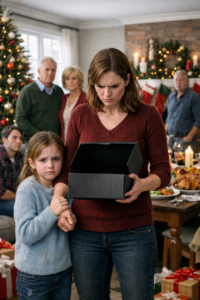
Something in my stomach dropped, heavy and certain. That instinct—the one that doesn’t use words—stood up and pointed.
Maisie looked up at me with wide, terrified eyes. She stood slowly, still holding the open box with both hands, like it might explode if she moved too fast.
She walked toward me on stiff legs. People parted without thinking about it, because adults always make space for a child carrying something, assuming it’s cute, assuming it’s harmless.
Maisie reached me and clutched my hand. Her palm was cold and damp.
“Mommy,” she whispered, so quietly I almost didn’t catch it. “I’m scared.”
Her voice shook. Then she added, barely louder than breath, “Just look. Don’t say it.”
My throat closed.
I looked down into the box.
At first, I didn’t understand. It was a toy—plastic, bright colors, the kind of cheap flying creature you find in a toy aisle near the checkout. Harmless. Ordinary.
Then my eyes caught a tiny detail, and my mind did the thing it does when something doesn’t fit reality—it tried to force it into a shape it could live with.
A hairline crack along one wing. A small black marker line near the tail, like a kid had drawn it there to tell the toy apart from another one.
My hands began to shake.
I knew that crack. I knew that marker line. I knew it the way you know the sound of your child’s footsteps.
Theo had carried that toy for weeks. He’d taken it everywhere—spun it through the air, made it “dive” off the couch, tucked it into his backpack like a secret talisman.
He’d had it the day he disappeared.
The room around me blurred. The Christmas lights on the tree seemed too bright, too cheerful, like they were mocking us. I could hear laughter, the rip of paper, someone calling out, “Who’s this from?” like nothing had changed.
Everything had changed.
I closed my fingers around Maisie’s hand, tight enough to ground both of us.
“Come on,” I said softly. “We’re going to get some air.”
Someone behind me asked, “Everything okay?”
I turned, and my face made the right shape. The polite shape. The shape women learn when they’re falling apart in public.
“She’s not feeling great,” I said. “Just stepping outside a minute.”
I didn’t wait for permission. I took the box from Maisie and walked her through the front door, down the porch steps, and across the driveway to our car.
The cold slapped my cheeks. It felt good. It felt like the only honest thing.
Maisie climbed into the back seat and curled into a ball with her knees up. She stared at the box like it was a snake.
I slid into the front seat but didn’t start the engine. I held the toy in my hands, turning it slightly, seeing the crack, the marker line, the exact scrape on the underside from when Theo had dragged it across the sidewalk.
I pressed my lips together hard, because I could feel tears trying to break through and I didn’t want Maisie to see me shatter.
But my voice came out anyway, rough and broken. “Where did Sadie get this?”
Maisie’s answer was a whisper from the back seat.
“I don’t know,” she said. “But… Theo had it. He showed it to me. He said it was lucky.”
My fingers went numb.
Inside the house, someone started singing along to a Christmas song. My mother’s laugh rose above it like a bell. Somewhere, a child squealed with delight.
I stared straight ahead through the windshield at the glow of my parents’ windows, the warm yellow light spilling into the cold night like a lie.
Then I picked up my phone.
Two minutes later, I called the police.
Part 2
While we waited, Maisie and I sat in silence that felt like weight.
The air inside the car smelled faintly like pine from the little tree-shaped air freshener we’d hung weeks ago, back when we were still pretending we were normal people who worried about normal things.
Maisie’s breathing was fast. Shallow. Every so often she rubbed her thumb over the edge of her sleeve, the way she did when she was trying not to cry.
I wanted to climb into the back seat and wrap my body around her like armor. I wanted to drive away and never come back. I wanted to rewind time six months and stand in Theo’s cafeteria doorway like a guard.
Instead, I stared down at the toy until my eyes hurt, because looking away felt like letting it vanish too.
It didn’t make sense. It couldn’t.
Theo had never been to my parents’ house without us. He’d never been to Megan’s house at all. Megan lived twenty minutes away and liked to make a show of being “so busy” with her three kids, but she never invited anyone over unless she needed something.
So how did Theo’s toy end up wrapped in red foil and handed to my daughter as a Christmas gift?
The question sat in my lap like a brick.
And the truth, or whatever shape it took, waited behind it like a dark doorway.
If I wanted to explain why I knew—without a doubt—that toy was Theo’s, you’d have to understand the way our family kept score of love.
I’m the older sister.
Five years between me and Megan, which might as well have been a lifetime in our house. I was the one my parents counted on. The one who didn’t yell, didn’t slam doors, didn’t get suspended for “talking back.” I got straight A’s, did dishes without being asked, learned early that praise was something you earned by making yourself easy.
Megan was the opposite. Loud, impulsive, charming. She lit up a room and burned it down in the same breath. And my parents—especially my mother—treated her like a sparkling disaster they couldn’t look away from.
Megan could do something wrong and my mother would say, “She’s just sensitive.”
I could do something right and my mother would say, “Good. That’s expected.”
As teenagers, the pattern hardened into cement. Megan drove too fast, ran with friends who drank in parking lots, skipped class. I drove her home. I lied for her. I cleaned up whatever mess she left, because if I didn’t, my parents would punish us both.
In our family, consequences were shared only by the responsible person.
When Megan got married, everyone acted like it was redemption. She had three kids in quick succession, like she was trying to outrun herself. She posted smiling photos online with captions about blessings and chaos, and my mother ate it up like proof that Megan was “doing great.”
But off-camera, Megan stayed Megan.
Late-night texts would arrive: Can you help? It’s for the kids.
At first, I did. I sent grocery gift cards. I paid a utility bill once. I made excuses because I couldn’t stand the thought of children going without.
Then I started noticing the pattern. The “kids” money would be followed by photos of Megan’s new nails, Megan’s new purse, Megan’s “self-care day” at a spa.
The last time she asked, I finally said what I’d been swallowing for years.
“No,” I told her. “You have a husband. I have a family. I can’t keep doing this.”
She went quiet for a week. Then she sent a single message: Wow. Okay.
In Megan language, that meant I had committed a betrayal.
By then, my life was already built around a different kind of family.
I met Owen when I was twenty-nine, at a friend’s backyard barbecue where I was helping clear plates because old habits die hard. Owen was the man standing slightly apart from the group, watching a little boy toddle across the grass like he was made of glass.
Theo was barely over a year old. He had big brown eyes and a seriousness that didn’t match his tiny body. When he fell, he didn’t cry right away—he looked around first, as if deciding whether the world was safe enough to admit pain.
Owen’s ex—Theo’s biological mother—had left when Theo was ten months old. No custody battle. No dramatic fight. She signed papers, packed a bag, and vanished like she’d been erased.
Owen didn’t speak bitterly about her, which was the first thing that made me trust him. He spoke carefully, like he didn’t want Theo to inherit anger.
Theo warmed to me in small steps. He’d bring me a book and sit close enough that our shoulders touched, then pretend it was nothing. He’d reach for my hand in parking lots, then drop it quickly if he noticed.
The first time he called me Mom, it slipped out during a feverish night when he was half asleep. Owen and I froze, looking at each other over Theo’s small sweaty head.
I didn’t correct him.
Neither did Owen.
When Maisie was born, two and a half years later, Theo treated her like she was his responsibility. He’d fetch diapers. He’d sing nonsense songs to make her laugh. He’d lean over her bassinet and stare at her like he was memorizing her face in case the world stole her too.
They grew up tangled together. Not half siblings. Not step anything. Just brother and sister. Loud, inseparable, built into each other’s lives the way breathing is built into a body.
Then six months ago, Theo disappeared.
It happened during lunch. He told the cafeteria aide he needed something from his backpack. He walked out of the room, and he never came back.
Teachers searched the halls. The school went into lockdown. Police arrived. Owen and I drove there like our hearts were trying to tear through our ribs.
There was security footage of Theo walking down the hallway. Then nothing. No image of him leaving the building. No adult leading him by the hand. No van in the parking lot captured at the right angle.
His backpack was found a few blocks away behind a hedge, dumped like trash.
No ransom. No call. No note.
Just absence.
The police did their job. They canvassed neighborhoods. They asked questions. They put out an alert. They patted Owen’s shoulder with pity eyes that made him want to scream.
Weeks passed. Then months. The world continued to spin like it didn’t care.
Owen stopped talking much. He moved through our house like a ghost, touching Theo’s abandoned shoes, straightening Theo’s bed like Theo might walk back in and need it neat.
Maisie cried in her sleep, little broken sounds that made me sit beside her with my hand on her back until morning.
I became the person who checked my phone every five minutes, then hated myself for hoping every unknown number would be the worst news.
By Christmas, we were hollowed out. But we promised each other we would make the day gentle for Maisie.
We didn’t know the day was waiting to crack us open.
The police cruiser turned onto my parents’ street with slow, steady lights. Not the screaming red-and-blue of emergencies, but the calm flash of procedure.
My stomach flipped anyway.
An officer stepped out, then another. Their faces were neutral, trained.
I opened the car door, holding the gift box like it was evidence of an earthquake.
I met them halfway up the driveway. My voice sounded far away, like it belonged to someone else.
“My daughter received this,” I said. “And it belongs to my son. He’s missing.”
The officer looked at the toy, then at me. His eyes sharpened.
“Where did she get it?”
I glanced back at my parents’ front window glowing with warmth and laughter.
“Inside,” I said. “At Christmas.”
Part 3
When the officers walked into my parents’ living room, it was like someone opened the front door and let winter into everyone’s bones.
Conversation stumbled. Laughter died mid-breath. Wrapping paper stopped ripping. A child asked, too loudly, “Are we in trouble?”
My mother’s face did that tight smile she used when the world embarrassed her.
“Oh,” she said, too bright. “Officers! Is everything all right?”
The officers didn’t match her tone. They scanned the room, clocking the tree, the presents, the faces.
One of them held the toy in a gloved hand like it could bite.
“We need to speak to the child who gave this gift,” he said. “And her parent.”
Sadie, Megan’s oldest, was standing near the couch, clutching a new stuffed animal. She looked from the police to Megan, confusion sliding into fear.
Megan’s wine glass stopped halfway to her lips.
“What is this?” she asked, laughing lightly like this was a joke she hadn’t been told. “Is this about some toy?”
The officer’s gaze didn’t move. “Ma’am, we need to speak privately.”
My mother stepped forward as if she could physically block reality.
“Is that necessary?” she said. “It’s Christmas.”
The officer looked at her with a patience that had limits.
“Yes,” he said. “It is.”
They moved to the den. Megan followed, still wearing that practiced smile. Sadie trailed behind, eyes wide. The room stayed frozen, everyone suddenly fascinated by their own hands, their own drinks, the tree lights.
Owen arrived while the den door was shut.
He came in quietly, shoulders hunched against the cold, and the moment he saw my face, he knew.
I didn’t have to say a word.
He stood beside me like a pillar, his jaw clenched so tight a muscle jumped near his ear.
Through the den door, voices murmured. Not loud. Not angry. Just questions being asked and answers being shaped.
After what felt like hours, the officers came back out.
They thanked Megan. They told her they would follow up. They took the toy, sealed in a bag.
The whole thing was calm enough that, for a split second, my mother looked almost triumphant—like calm meant harmless.
Then the officers left, and their taillights disappeared down the street, and the house was left holding its breath.
Nobody resumed opening presents.
Nobody turned the music back on.
My mother tried once, fluttering her hands as if she could wave normal back into place.
“Well,” she said, voice brittle. “That was… unexpected. Let’s not let it ruin the day.”
Owen didn’t look at her.
I didn’t either.
Because the day was already ruined, and she didn’t get to decide otherwise.
We stayed for another hour only because Maisie was exhausted and I didn’t trust myself to drive without shaking. People moved around us like we were glass. Megan avoided my eyes. Sadie kept glancing toward the door like she wanted to run.
When I finally stood, Owen stood too. We didn’t announce our departure. We simply left.
Outside, the cold air was sharp and honest. It filled my lungs like punishment and relief.
On the drive home, Maisie fell asleep in the back seat, curled around her new stuffed animal like a shield.
Owen stared straight ahead, hands white-knuckled on the steering wheel.
The streetlights slid over his face in stripes. In the dark, he looked older than he had six months ago, carved down by grief.
“I know that toy,” he said finally, voice low. “I know it.”
“I know,” I whispered.
He swallowed hard. “So how—”
“I don’t know yet,” I said. “But I’m going to.”
We got Maisie into bed, still dressed, her hair smelling like my mother’s cinnamon house. She murmured Theo’s name once in her sleep and turned her face into her pillow.
Owen stood in Theo’s room for a long time, not touching anything, just looking. Theo’s bed was made neatly, because I couldn’t stand leaving it rumpled. Theo’s backpack hooks were empty. His comic sketches were still taped to the wall—little superheroes with big hearts and crooked smiles.
Owen’s shoulders shook once, barely, like a tremor.
Then he turned to me with eyes that looked too awake.
“Megan knows something,” he said.
It wasn’t a question. It was a verdict.
My mind replayed Megan’s face when the officers asked to speak privately. The way her smile had flickered. The way she’d held her wine glass too carefully, as if she needed it to stay upright.
I thought of Sadie’s handwriting on the tag. The way Sadie had said, proudly, that she made Maisie something.
I didn’t want to believe a child could be part of something awful.
But children can be used. Children can be taught what to say. Children can be given objects and told to wrap them.
And Megan… Megan could always make someone else carry the cost.
“Owen,” I said, because his name felt like the only anchor in the room. “We should go back. Tonight. We should talk to her.”
He hesitated. His face moved through emotions too fast to name—rage, fear, hope, and something that looked like pain trying not to become a scream.
“What if Theo’s alive?” he whispered.
The words hit the air and hung there, dangerous and bright.
Hope is not gentle when you’ve been starving.
It feels like fire.
“We can’t do this alone,” I said. “But we can’t wait either.”
We drove back to my parents’ house.
The lights were still on, but the party was dead. Cars had left. The windows no longer shook with noise. Through the glass, I saw my mother moving around the kitchen, cleaning with angry jerks like she was punishing the countertops.
Megan’s car was still in the driveway.
We knocked. My father opened the door. His face looked tired, confused.
“What are you doing back?” he asked, as if we were rude for returning to our own disaster.
“We need to talk to Megan,” Owen said. His voice was calm, but it had the edge of a blade.
My father’s mouth tightened. “Now?”
“Yes,” I said. “Now.”
He stepped aside reluctantly. We walked past my mother without stopping. She started to speak, but Owen didn’t even glance at her. He headed toward the sunroom where Megan liked to sit and scroll through her phone like the world couldn’t touch her.
Megan was there, perched on the couch, her legs tucked under her. Her wine glass was gone. Her phone glowed in her hand.
She looked up and smiled too quickly.
“Hey,” she said. “Everything settled down?”
Owen took one step into the room and stopped. His whole body looked like it was holding back an explosion.
“We need the truth,” I said.
Megan blinked, then laughed softly. “About what? That toy thing? The police already—”
“He had that toy with him,” Owen cut in. His voice was rough, the calm cracking. “The day he disappeared.”
Megan’s smile froze.
“You can’t know that,” she said.
“We do,” I said. “Maisie knows. I know. Owen knows.”
Megan set her phone down slowly. Her eyes darted toward the doorway, like she was calculating escape routes.
“Why are you doing this?” she asked, and there it was—the familiar Megan move, turning her wrongdoing into someone else’s cruelty.
Owen stepped closer.
“We’ve been burying him alive in our minds every night for six months,” he said. “So don’t you dare act like we’re the problem.”
Megan’s face lost color.
She opened her mouth. Closed it. Swallowed.
Then, in a voice smaller than I’d ever heard from her, she said, “Please don’t tell them.”
My skin went cold.
“You mean there is something to tell,” I said.
Megan’s eyes filled but the tears didn’t fall. She looked at Owen like he was a judge, then at me like I was the only person in the room she’d ever truly feared.
“Tell us,” I said. “Right now.”
For a long moment, Megan just breathed.
Then she nodded once, like surrender.
“It was… it was Theo’s mom,” she whispered.
Owen’s face went blank.
My heart slammed against my ribs so hard it hurt.
Megan’s voice trembled. “She contacted me months ago. Out of nowhere. She said she just wanted to see him. She said she missed him so much and she couldn’t sleep and she’d made a mistake.”
Owen’s hands curled into fists.
“She left,” he said, voice deadly quiet. “She signed papers. She vanished.”
“I know,” Megan said quickly. “I know. But she said she’d changed. She said she just wanted one hour. One visit. That’s all.”
“And you believed her?” I asked, the words tasting like poison.
Megan flinched. “She offered me money.”
There it was. The true heartbeat under every Megan decision.
“I didn’t ask,” she rushed. “She just… offered. And you had stopped helping me and I was behind and—”
“You sold my child,” Owen said.
Megan sobbed once, sharp. “I didn’t think she’d take him. I swear. I thought she’d bring him back. She promised. She promised me.”
My vision blurred with rage. “So you arranged it.”
Megan nodded frantically. “I told her when he had lunch. She said she’d meet him outside. She said she’d bring him back before anyone noticed.”
Owen made a sound, low in his throat, like something breaking.
“And when he didn’t come back?” I asked.
Megan’s shoulders collapsed. “I panicked. I called her. She didn’t answer. I thought maybe she’d bring him back the next day. I thought… I didn’t know what to do.”
“You told no one,” I said.
Megan shook her head, crying now. “I couldn’t. Mom would’ve—”
“Mom would’ve what?” I snapped. “Yelled? Shamed you? And that was worse than letting us think he was dead?”
Megan’s sobs turned silent, her whole face crumpling.
“I’m sorry,” she whispered. “Please. I have kids. I didn’t mean—”
Owen stepped back like he couldn’t breathe the same air as her.
“We’re going to the police station,” I said.
Megan’s eyes widened in terror. “No—”
“Yes,” I said. “You don’t get to hide behind family this time.”
Owen didn’t speak. He walked out of the room like he was leaving a burning building.
I followed.
Behind me, Megan’s crying filled the sunroom, and my mother’s voice rose somewhere in the house—sharp, demanding, already choosing her side.
I didn’t turn around.
Part 4
The police station smelled like old coffee and disinfectant, like a place where other people’s worst days piled up in the corners.
We sat across from a detective who looked tired in the way people look when they’ve seen too many versions of the same human cruelty. He listened without interrupting as Owen and I told him everything Megan had said.
The money. The meeting. The timing. The silence.
I watched the detective’s pen move across paper in steady strokes, like our grief was just another report to file, but his eyes sharpened when Owen described Theo’s mother disappearing under a false name.
When we finished, the detective leaned back and exhaled slowly.
“Thank you,” he said. “I know this is… a lot. We’re going to handle it from here.”
Owen’s laugh was short and bitter.
“You’ve been handling it for six months,” he said. “And he’s still gone.”
The detective didn’t flinch. He looked at Owen with something close to pity.
“I get it,” he said quietly. “But this changes things. A lot.”
It did. Because for the first time in half a year, we weren’t staring into a blank wall. We had a door. A crack of light.
We went home and stared at our phones like they were oxygen tanks.
Maisie woke up and asked if Theo was coming back. Her voice was small, hopeful in that reckless way children can be, because she didn’t know yet how dangerous hope could feel.
I knelt in front of her and held her hands.
“I don’t know yet,” I said honestly. “But we’re doing everything we can.”
She nodded as if she understood. Then she whispered, “I don’t like Aunt Megan.”
Neither did I.
The next morning, Megan was arrested.
Not in a dramatic raid. Not with sirens. Just two officers showing up at her house while her kids watched cartoons and leading her out with her face wet, her hair unwashed, her mouth making excuses even as handcuffs clicked.
The charges were preliminary. Obstruction. Contributing to custodial interference. More pending.
My mother called me within an hour.
I stared at her name on my screen, feeling my stomach twist. Some part of me wanted to ignore it forever. Another part—the part trained since childhood to answer, to explain, to smooth things over—made my thumb move.
“Hello,” I said.
Her voice hit my ear like a slap.
“How could you do that to your sister?”
No hello. No breath. Just accusation.
I blinked. “She did it to herself.”
“You called the police on family,” my mother snapped, as if those words were the crime. “You humiliated her. You destroyed everything.”
I gripped the phone. My hand shook, not with fear now, but with something hotter.
“She arranged for Theo to be taken,” I said. “She knew. She didn’t tell us for six months.”
“She made a mistake,” my mother insisted. “She was trying to help. That boy has a mother. Maybe—”
Then she said the part that I will never forget, not because it was shocking, but because it was so perfectly her.
“It’s not like he’s your real son.”
The room went very still.
I looked across our kitchen at Owen, who stood by the counter with his hands braced on the edge, staring at nothing. He could hear my mother’s voice faintly through the phone speaker. I saw the way his shoulders tightened.
My mouth went dry.
“He is my son,” I said, each word deliberate. “And you don’t get to decide who belongs in my family.”
My mother huffed, offended, like I was being dramatic.
“Megan is your sister,” she said. “Blood matters.”
I felt something in me finally, quietly, snap.
“So did you,” I said. “You made a choice, too.”
Then I hung up.
I didn’t throw my phone. I didn’t scream. I simply set it down on the table like it was a thing I no longer needed.
Owen didn’t ask what she said.
He didn’t have to. He just reached across the counter and took my hand, and for the first time in months, his grip felt like something other than desperation.
Three days passed.
They were the longest three days of my life, and I have lived through childbirth and the day Theo disappeared and the night I found the toy in a Christmas box.
We didn’t sleep. We didn’t eat much. We sat on the couch with the TV on but muted, because silence was worse and sound was unbearable.
On the third day, the phone rang.
Owen grabbed it so fast he almost dropped it. He stared at the screen, then looked at me with eyes wide and terrified.
“It’s the detective,” he whispered.
He answered, put it on speaker, and didn’t speak.
“Mrs. Gray?” the detective’s voice came through. “We found her. Theo’s biological mother.”
My lungs stopped working for a second.
The detective kept going, like he knew we’d collapse if he paused too long.
“She’s been living under a false name in Arkansas,” he said. “We’ve got her in custody.”
Owen’s face went gray.
“And Theo?” I managed to ask. My voice sounded like it belonged to someone drowning.
There was a beat of silence.
“He’s alive,” the detective said.
My legs gave out. I slid down the cabinet and sat on the kitchen floor, hand over my mouth, because the sound trying to come out of me was too big, too ugly, too holy.
Owen sank to his knees beside me, his forehead pressing against the counter like he couldn’t hold himself up.
The detective’s voice softened. “We’re arranging a video call. It’s not ideal, but we want you to see him as soon as possible.”
I nodded even though he couldn’t see me.
“Yes,” I whispered. “Yes. Anything.”
At the precinct, they led us into a small room with a table and a laptop. A tech guy clicked keys like this was normal. Like our entire world wasn’t balanced on a screen.
Owen sat beside me, stiff as stone. His hands were clasped so tightly his knuckles looked bruised.
The screen flickered.
Then Theo appeared.
He looked different. Taller. Thinner. Paler. His hair was longer, curling at the ends like he hadn’t had a proper haircut in months. His eyes were the same, though—those big brown eyes that looked like they’d learned too much too fast.
For a second, he just stared at us like he wasn’t sure we were real.
My heart cracked open.
“Theo,” I whispered.
He blinked, slow.
“Hi,” he said quietly.
My voice broke. “Hi, sweetheart.”
He glanced off-screen, like someone was watching him. Then he looked back at us.
“She told me you didn’t want me,” he said. His voice didn’t accuse. It just stated, like a child repeating something that had been hammered into him.
Something inside me splintered.
“No,” I said, shaking my head hard. “No, that’s not true. We never stopped looking for you. Not once.”
Owen leaned forward. His voice came out steady but thin, like a wire stretched too tight.
“You’re ours,” he said. “Always.”
Theo’s mouth trembled. He swallowed.
“I didn’t believe her,” he whispered. “Not at first. But she kept saying it. And… I didn’t know what to think.”
“You know now,” I said. “You know now.”
Theo nodded once, small and careful.
The tech guy murmured something about time. The detective on the other end said they had to end the call soon.
Owen spoke quickly, like he was afraid the world would steal this chance too.
“We’re coming,” he said. “We’re coming to get you.”
Theo’s eyes held on ours for a long second.
“Okay,” he said softly. “I’ll be here.”
The screen went dark.
I sat there staring at my own reflection, my face wet, my hands shaking.
Theo was alive.
And that meant everything we’d been grieving wasn’t over.
It was beginning again, in a different shape.
Part 5
Theo came home on a Thursday, and I remember that detail because my brain clung to anything solid.
We drove to the train station because the state didn’t want a long road transport with him after everything, and because logistics can be cruelly ordinary even when your life is split in half.
The platform smelled like metal and damp air. People bustled past with luggage and coffee cups, annoyed at delays, checking watches, living their normal days while we stood behind the yellow line like it was the edge of a cliff.
Maisie bounced on her toes, her hands jammed into her coat pockets.
“Will he look the same?” she asked for the tenth time.
“I don’t know,” I said.
Owen didn’t speak. He stared down the track, jaw clenched, eyes too bright.
When the train finally slid in with a scream of brakes, my heart slammed so hard I thought I might throw up.
A caseworker stepped off first, scanning the platform. Then a small figure appeared beside her with a duffel bag that looked too big for his body.
Theo.
He froze at the top of the steps like he wasn’t sure the ground was safe. His eyes swept the crowd.
Then he saw us.
He hesitated, like the sight of us hurt because it was real.
Maisie didn’t hesitate at all. She ran.
“Theo!” she screamed, and her voice cracked in the middle like a firework.
Theo dropped the duffel and caught her in his arms. For a second he just held her, stiff, like he didn’t trust his hands. Then his arms tightened around her like he’d been starving.
Maisie buried her face in his coat and sobbed, loud and unashamed.
“I missed you,” she cried. “I missed you so much.”
Theo’s hand moved to her hair in a shaky pat. His eyes squeezed shut.
Owen took a step forward, then stopped.
His face was stone. His eyes were shining. His hands hung useless at his sides, like he didn’t know how to touch his own son without breaking.
I walked up slower, my breath coming in short bursts.
Theo lifted his head and looked at me over Maisie’s shoulder. His eyes were cautious.
I knelt in front of him, ignoring the cold seeping through my jeans.
“Hi,” I said softly. “I’m here.”
Theo stared at me for a long moment. Then he stepped forward and pressed his face into my coat, the way he used to when he was little and overwhelmed.
My arms wrapped around him on instinct, tight and careful, like I was holding something fragile.
That was the moment I believed he was really back.
The next weeks were not a movie montage. They were messy. Slow. Sharp-edged.
Theo flinched at doors closing too fast. He startled when Owen raised his voice even slightly, even if Owen was just calling from another room.
He slept with the light on. When the house creaked at night, he sat up like he expected someone to take him again.
Maisie stuck to him like glue, trailing him down hallways, sitting outside the bathroom door, hovering like she believed her presence could act as a lock.
We got him into therapy immediately, because love alone doesn’t undo trauma, and pretending otherwise is how families like mine get made.
Owen went too, though he resisted at first. He didn’t like talking to strangers about pain. But he sat in the therapist’s office with his hands clenched and said, “I don’t know how to stop being afraid.”
And that honesty was the first brick of something new.
Theo didn’t tell us much at first. He spoke in short answers, like words cost too much.
We learned the basics from the caseworker and the detectives.
Theo’s biological mother had been living in Arkansas under a fake name, moving between rentals, always one step ahead of paperwork. She told Theo stories about how Owen didn’t want him, how I wasn’t really his mother, how he was “supposed” to be with her.
She kept him close, but not gently. More like possession than care.
Theo said later, in a quiet moment on the couch, “She cried a lot. Then she got mad when I didn’t cry with her.”
He paused, staring at his hands.
“I didn’t know what to do,” he whispered.
My throat tightened. I put my hand over his.
“You didn’t do anything wrong,” I said.
He didn’t look convinced. But he nodded, because nodding was easier than believing.
Megan’s court date came fast.
She took a plea deal: eighteen months in county, probation, restrictions. The words sounded clean and legal, nothing like the reality of what she’d done.
She cried in court. She said she didn’t mean for Theo to be taken. She said she was just trying to help someone reconnect with their child. She said she was sorry.
The judge listened, then said, flatly, that intent did not erase danger.
I sat in the courtroom with Owen beside me, our knees almost touching. Maisie was with my friend at home because she didn’t need to see that.
Owen didn’t look at Megan once.
When the sentence was read, Megan turned toward us, eyes desperate, like she expected us to rescue her from consequence the way I always had when we were kids.
I didn’t move.
I didn’t even blink.
Theo’s biological mother was sentenced separately. She pled guilty to custodial interference and endangerment. In court she said she wasn’t trying to hurt him, she just missed him, she wanted to fix what she broke.
No one clapped. No one softened.
Afterward, my mother cornered me in the hallway outside the courtroom like she could still control the narrative.
“This is too much,” she hissed. “Megan is your sister.”
I looked at her. Really looked. The lines around her mouth. The anger in her eyes. The way she was still trying to bargain.
“And Theo is my son,” I said.
She scoffed. “He has a real—”
I cut her off, voice ice. “If you say that word again, you will never see my children.”
My mother’s eyes widened, shocked that I’d drawn a line she couldn’t step over.
I turned and walked away.
Owen and I made the decision that night: we were done begging for approval from people who measured love in blood and convenience.
We blocked my parents’ numbers.
We stopped answering emails.
We let silence build a wall where there should have been family, because sometimes walls are what keep you alive.
Part 6
Spring came slowly, like the world was hesitant to bring new life near our wreckage.
In March, Theo started drawing again. At first it was just scribbles, angry slashes of color. Then it became shapes. Then characters.
He drew a small boy with a cape and a girl with a sword, always standing side by side. He drew monsters with sharp teeth and big eyes, and sometimes he drew the monsters trapped behind walls.
One afternoon, I found Theo and Maisie sprawled on the floor in his room with markers and paper scattered like confetti.
Maisie looked up at me with an earnest face. “We’re making a comic,” she announced.
Theo didn’t look up right away. When he did, his eyes met mine with something close to calm.
“Can we get pizza tomorrow?” he asked.
It was the first full, normal sentence he’d spoken in days.
I felt tears sting my eyes, ridiculous and sudden.
“Yes,” I said, and my voice came out steady. “We can get pizza.”
Owen stood behind me in the doorway. I felt his hand settle lightly on my shoulder, like a silent thank you for catching these small moments.
Recovery wasn’t linear. Some nights Theo woke up screaming. Some days Owen snapped at a noise and then apologized immediately, voice shaking. Sometimes I walked into the pantry and cried into a bag of flour because I couldn’t find any other place to put the fear.
But there were also ordinary mornings. School lunches. Homework battles. Maisie’s hair in messy braids. Theo’s sneakers left in the hallway like a normal kid’s mess.
We celebrated Theo’s “home day” in April without calling it that. We just made pancakes and let him choose the movie and didn’t talk about the date like it was fragile glass.
The detectives told us more details as the case moved through legal channels. Megan’s phone had records of calls. Messages from Theo’s mother. A transfer of money.
Evidence makes betrayal feel heavier because it’s not just emotion. It’s proof.
One day a detective asked if we wanted to pursue further charges or civil actions, and Owen said, “I want my son safe.”
And that was the only answer that mattered.
We installed new security cameras, not because cameras stop pain, but because control is a comfort when you’ve lived without it.
We changed routines. We made code words for pick-ups. We taught Maisie and Theo that secrets are different from surprises, and that adults who ask you to keep a secret are dangerous.
It felt awful to teach children that.
It felt necessary.
In June, Theo’s therapist suggested something that made Owen stiffen: adoption.
Legally, Owen had custody, but I wasn’t Theo’s legal parent. In our house, that had never mattered—until it did.
Theo’s biological mother had no contact orders and a sentence, but legal systems are complicated. People appeal. People resurface. People with obsession don’t always stop.
Adoption would make Theo mine, legally, forever.
Owen and I talked about it late at night after the kids were asleep. The kitchen lights were off except for the glow above the stove.
“I don’t want him to think we’re replacing anything,” Owen said, voice low.
“We’re not,” I said. “We’re protecting what already exists.”
Owen’s eyes were tired. “Do you think he’d want it?”
“I think he wants certainty,” I said.
We brought it up gently with Theo, careful not to make it heavy.
We were sitting on the couch, Theo with a blanket over his legs, Maisie asleep on Owen’s shoulder.
“Theo,” I said quietly. “Can I ask you something?”
Theo’s eyes narrowed a little, wary.
I took a breath. “You know I love you, right?”
He nodded, quick.
“And you know… I’m your mom in this house,” I said. “But there’s paperwork stuff that doesn’t always match what’s real. We have an option to make it match. To make it official.”
Theo stared at his hands.
Owen leaned forward. “It would mean—legally—your mom would be your mom the way I’m your dad. Nobody could change that.”
Theo’s mouth pressed into a line. He didn’t answer right away.
Then he whispered, “Would I have to change my name?”
“No,” I said. “Only if you wanted to.”
He thought. His eyes flicked toward Maisie, asleep, her head tipped back, mouth open slightly.
Then he looked at me.
“I don’t want to be taken again,” he said, voice small.
My chest tightened.
“You won’t,” Owen said fiercely.
Theo swallowed. “If it helps… then yeah. I want it.”
Owen’s eyes filled. He turned his face away quickly, like he was embarrassed by tears.
I reached for Theo’s hand.
“Okay,” I whispered. “We’ll do it.”
The adoption process was paperwork and interviews and home visits. It was strange to have strangers evaluate our love like it was a file to approve, but we did it anyway. We answered questions. We signed forms. We proved what we already lived.
In September, we stood in a small courtroom with Theo between Owen and me and Maisie perched in the front row swinging her legs.
The judge smiled kindly and asked Theo if he understood what adoption meant.
Theo’s voice shook a little, but he answered, “It means she’s my mom forever.”
I blinked hard.
The judge nodded. “That’s right.”
When the gavel came down, it sounded like a door locking.
Not a cage.
A home.
Part 7
The first Christmas after Theo came home, we didn’t go to my parents’ house.
We didn’t even debate it.
We stayed in our own living room, in our own quiet, and we built a new tradition out of stubbornness and love.
We decorated the tree together, the four of us. Theo insisted on putting the star on top, standing on a chair while Owen held his waist. Maisie argued that she should do it because she was “the youngest and cutest,” and Theo rolled his eyes in a way that made my heart lift because it was normal sibling drama, not trauma.
On Christmas Eve, we made hot chocolate and watched a movie and let the lights glow without anyone’s passive-aggressive humming in the background.
But the past didn’t vanish just because we changed the scene.
In January, Megan wrote a letter.
It arrived in an envelope with her handwriting on the front, loopy and familiar. My stomach turned just seeing it.
Owen took it from my hands without a word, walked to the fireplace, and held it over the flame. The paper curled and blackened, the words disappearing before we ever read them.
I watched the smoke rise and felt something loosen in my chest.
“Do you ever feel bad?” I asked quietly.
Owen didn’t look at me. “Not for her,” he said. “I feel bad for the person I used to be, who thought family meant we had to forgive anything.”
I nodded. Because that was exactly it.
My parents tried to push back into our lives in small ways. A birthday card in the mail. A voicemail from an unknown number. A neighbor who mentioned my mother was “heartbroken.”
Heartbroken.
As if heartbreak belonged to them.
One afternoon in March, my father showed up at our door.
I saw him through the window, standing on the porch with his hands shoved into his pockets like he didn’t know what to do with them. He looked older. Smaller.
Owen was at work. The kids were in the backyard. It was just me and the echo of my childhood.
I opened the door but didn’t invite him in.
“Hi,” he said, voice awkward.
“Hi,” I replied.
He glanced past me, eyes searching for signs of the kids. “I… I wanted to see them.”
My throat tightened. “You can’t.”
He flinched. “Because of your mother?”
“Because of both of you,” I said evenly. “You stood there and let her say he wasn’t real.”
My father’s jaw worked. “She didn’t mean—”
“Yes,” I interrupted. “She did. And you let her. And you let Megan be protected while my family was destroyed.”
His eyes dropped. “Megan’s in jail,” he muttered, like that was punishment enough.
“She should be,” I said.
He looked up, eyes wet. “We made mistakes.”
I didn’t soften. Not because I didn’t feel the ache of it, but because I knew what softness had cost me for decades.
“Mistakes are forgetting someone’s birthday,” I said. “Not selling access to a child. Not defending it. Not telling us he wasn’t real.”
My father’s shoulders slumped.
“I miss you,” he said quietly.
I stared at him, surprised by the honesty. My father was not a man of emotional sentences.
I felt something in me waver—an old longing, a childhood need.
Then I heard Theo and Maisie laughing outside, their voices bright.
And that sound made my spine straighten.
“I miss the idea of having parents I could trust,” I said. “But that’s not what I have.”
My father swallowed. “What can we do?”
I shook my head. “You can leave,” I said gently. “And you can live with the choices you made.”
He stood there a moment longer, eyes searching mine for a crack.
I didn’t give him one.
When he finally turned and walked down the steps, I closed the door and leaned my forehead against it, breathing hard.
In the backyard, Theo shouted something triumphant—he and Maisie were racing, and he had won.
I walked out to them with a smile that felt earned.
By summer, Theo was sleeping through most nights. He still had moments—certain songs, certain smells, certain news stories could pull him under—but he came back faster now. He had tools. He had words.
Sometimes he talked about Arkansas in small fragments, never the full story. We never forced it.
Maisie, too, healed in her own way. She stopped checking locks every night. She stopped jumping when Owen left the room. She stopped asking, “Are we okay?” with that thin voice that sounded like fear in costume.
Owen started laughing again. Not often at first, but then more. One night, after Theo made a joke at dinner and Maisie nearly choked on her water from laughing, Owen leaned back and let out a sound I hadn’t heard in over a year—full, surprised laughter, like he’d forgotten it existed.
I watched him and felt my own eyes sting.
We didn’t become untouched. We became rebuilt.
And rebuilt things have scars, but they also have strength.
Part 8
Megan got out early for good behavior, which is the kind of sentence that makes your stomach twist if you’ve been the one good behavior never protected.
She tried to contact us through a cousin, then through an email address I didn’t recognize, then through a new phone number that left a voicemail full of tears and “I just want to explain.”
We blocked them all.
The court ordered no contact with us as part of her probation, but Megan had always treated rules like suggestions, and my mother treated Megan like an exception to reality.
One afternoon, almost two years after that Christmas, we were at a park.
Theo and Maisie were climbing a rope structure, arguing about who got to be “captain.” Owen sat beside me on a bench, sipping a coffee.
It was one of those quiet moments that feel like victory.
Then I saw her.
Megan stood near the edge of the playground, sunglasses on, hair dyed a shade that tried too hard. She held her phone in front of her like she was pretending to text, but her head tilted toward the kids.
My blood went cold.
Owen followed my gaze and stiffened.
Theo saw her too, because children notice what adults wish they hadn’t.
He froze mid-climb. His face went pale, the way it had on that first Christmas, only now it was his fear, not Maisie’s.
Maisie looked at Theo, confused, then followed his stare.
“Owen,” I said softly, voice tight. “Call.”
Owen pulled out his phone without a word.
Megan took a step forward.
I stood up and moved toward the playground fence, putting my body between her and the kids.
“Megan,” I said, loud enough for her to hear, calm enough not to scare Theo more.
She stopped. Her mouth trembled.
“I just want to see them,” she said, voice pleading. “I’m their aunt.”
“You’re a threat,” I said flatly.
Tears spilled behind her sunglasses. “I didn’t mean—”
“Stop,” I snapped, and my voice cracked with anger. “Stop making it about what you meant.”
She flinched, the way she used to when our mother’s disappointment finally cut through her charm.
Theo climbed down slowly, his eyes locked on Megan, his body tense like a cornered animal.
Owen stood beside me now, phone still to his ear, shoulders squared.
Megan’s face crumpled. “Theo,” she whispered. “I’m sorry.”
Theo’s voice came out thin and sharp. “You knew,” he said.
Megan’s sobbing sound was ugly. “I was scared,” she said. “I didn’t know what to do.”
Theo’s eyes glistened. “You could have told my dad,” he said. “You could have told my mom.”
The word mom landed in the air like a weight and a gift.
Megan’s shoulders shook.
Then Owen’s voice cut in, ice and steel.
“The police are on their way,” he said. “You need to leave. Now.”
Megan stared at him like she expected him to soften.
He didn’t.
She backed away, trembling, then turned and walked fast toward the parking lot, wiping her face, disappearing like a coward.
A patrol car arrived minutes later. Owen spoke with the officer. I held Theo’s hand so tightly my fingers ached.
Theo’s breathing was fast, but he didn’t cry. He just stared at the ground, jaw clenched.
When the officer left and the park settled back into normal noise, Theo finally spoke.
“I hate her,” he said quietly.
I swallowed, choosing honesty over tidy morals.
“You’re allowed to,” I said. “Hate is what your heart does when it knows something was wrong.”
Theo nodded, then whispered, “Will she keep coming?”
Owen crouched in front of him, hands on Theo’s shoulders, eyes fierce.
“No,” Owen said. “Not anymore.”
And he meant it. He filed the report. He pushed for enforcement. He didn’t let “family” blur boundaries.
That night, Theo asked to sleep with his door open, and Maisie dragged her blanket into Theo’s room without asking, flopping onto the floor like a guard dog.
Theo looked at her and sighed, exasperated.
“You’re weird,” he told her.
Maisie grinned. “I’m loyal.”
Theo’s mouth twitched at the corner, almost a smile.
Owen and I stood in the hallway watching them, and for a moment the fear loosened its grip.
Not because the world was safe.
Because we were.
Part 9
Years pass in strange ways after something like that. Time doesn’t heal so much as it layers. The sharp edges dull, but the shape remains.
Theo is twelve now. He’s taller than I am on good posture days. He plays soccer, not because he loves it, but because he loves being on a team that trusts him to show up and stay.
Maisie is ten and opinionated enough to run a small country. She and Theo fight like siblings do, and every time they do, I feel grateful because it means they feel secure enough to be normal.
Owen still has nights when he wakes up suddenly, sitting upright, listening. Sometimes I reach for his hand in the dark and he grips mine like a lifeline.
We don’t pretend those nights don’t happen.
We also don’t let them define us.
My parents remain a closed door. Sometimes I think about them on birthdays, on holidays, when I see other families posting smiling pictures online. I feel a small ache, like an old bruise.
Then I remember my mother’s voice saying, “Not your real son.”
And I remember how easily she offered Theo up to protect Megan.
Some doors should stay closed.
Megan, as far as I know, moved to another town. I heard through distant family that she calls herself “misunderstood.” That she tells her kids Auntie was “mean.” That she claims she was “trying to help.”
Maybe she believes it. Megan always preferred stories where she was the wounded hero.
The truth is simpler: she made a choice. She traded a child’s safety for money and comfort, then chose silence over honesty.
I don’t wonder anymore what kind of person does that.
I know. I grew up with her.
But I also know what kind of person stops cleaning up her mess.
Me.
Last Christmas, Theo asked if we could go somewhere new.
“Like a trip?” I asked.
He shrugged, pretending it didn’t matter, but his eyes flicked to the window as if he was watching for shadows.
“Maybe,” he said. “Just… not at anyone’s house.”
Owen nodded immediately. “Done,” he said.
So we rented a small cabin in the mountains. Nothing fancy. A fireplace, a kitchen, snow outside like a postcard.
We brought board games. We brought hot cocoa. We brought our own decorations in a box, including the tacky glitter ornament Maisie made in kindergarten and the crooked wooden star Theo painted the year he came home.
On Christmas morning, we opened gifts slowly. No crowd. No forced laughter. Just paper tearing and quiet smiles and the soft crackle of the fire.
Maisie handed Theo a small box.
Theo raised an eyebrow. “What is this?”
Maisie grinned, proud. “Open it.”
Theo lifted the lid and paused.
My heart stuttered, an old reflex.
Then Theo laughed—an actual laugh, surprised and delighted.
Inside was a tiny handmade comic book Maisie had stapled together. The cover showed a boy with a cape and a girl with a sword and, behind them, a house with a big lock drawn on the door.
Theo flipped through the pages. Each panel showed them fighting monsters that looked suspiciously like fear, shame, and a woman with sunglasses.
The last page showed them standing in front of the house, safe. A speech bubble came from the girl: We don’t let bad people be family just because they say so.
Theo looked up at Maisie, his eyes shiny.
“You made this?” he asked.
Maisie nodded, suddenly shy. “Yeah.”
Theo set the comic down carefully and pulled her into a hug.
“Thanks,” he said, voice thick.
Maisie hugged him back hard. “You’re stuck with me,” she whispered.
Theo rolled his eyes. “I know.”
Owen watched them with his arm around my shoulders. His chin rested against my head.
In that quiet cabin, with snow pressing against the windows and our small family breathing in the same warm space, something in me finally settled.
Because the story didn’t end the day Theo came home.
It didn’t end when Megan went to jail.
It didn’t end when my mother tried to claim love belonged to blood.
The story ended the day Theo stopped looking over his shoulder.
Not because the past disappeared, but because the future grew bigger than it.
Later that night, Theo stood beside me at the sink, drying dishes.
He handed me a plate and said, casually, like it was nothing, “Mom?”
I froze for half a second, because even after all these years, the word still hits me like a gift.
“Yeah?” I said, keeping my voice steady.
Theo stared down at the towel in his hands.
“Back then,” he said quietly, “when I was gone… I thought maybe I wasn’t worth coming back for.”
My throat tightened.
Theo kept going, voice low. “But you did. You kept looking. You didn’t stop. Even when people told you to.”
I set the plate down gently.
“I will never stop,” I said, and the promise felt carved into my bones.
Theo nodded once, then bumped my shoulder lightly with his like he was trying to hide emotion inside a normal gesture.
“Good,” he said.
He walked away to join Maisie by the fire.
Owen caught my eye from across the room and smiled, tired but real.
Outside, snow fell in steady silence.
Inside, we were home.
THE END!