At 15, My Parents Believed My Sister’s Lie And Kicked Me Out In A Storm. “GET OUT. I DON’T NEED A SICK DAUGHTER.” 3 Hours Later -Police Called Them To The Hospital. When Dad Walked In And Saw Who Was Sitting By My Bed, His Hands Wouldn’t Stop Shaking. “YOU… YOU CAN’T BE HERE…
Part 1
My name is Olivia Sterling. I’m twenty-eight now, and most days the past feels contained—labeled and stored somewhere I don’t have to touch. But every October, when cold storms roll in, my body remembers. I remember the night my parents told me to leave, and how easily a lie erased me.
In our house, Madison’s feelings were treated like fine glass. Mine were treated like background noise. When I was eleven, I won first place at a regional science fair for a homemade water filtration system. I ran into the kitchen with the blue ribbon in my hand, breathless, proud. Mom hugged me and told me I was brilliant—until Madison came in crying about dance practice, and Mom’s attention slid off me like water off wax.
By fourteen, I’d learned to take up less space. When I earned a full scholarship to a two-week summer science camp, I floated with hope until Madison heard the news and burst into tears at dinner.
“It’s not fair,” she said. “She gets to leave and I don’t.”
Mom’s face tightened with guilt. Dad barely looked up. “Olivia,” Mom said, “maybe you could skip it this year. Your sister needs you here.”
I didn’t go. My parents called it being the bigger person. I called it disappearing.
Madison’s lying started small and got bolder the more it worked. If she took my sweater, she denied it. If I pointed out the sweater on her bed, Mom sighed that I was “starting drama.” When fifty dollars disappeared from Mom’s wallet, Madison said she’d seen me near it. Dad hauled me into his study and demanded I confess.
“I didn’t take it,” I said.
“Madison wouldn’t lie,” he snapped.
I lost privileges. Madison watched from the stairs with wet lashes and a secret smile. After that, everything became my fault by default: a broken vase, a failed test, a rumor at school. Defending myself felt like shouting into wind. I stopped.
At fifteen, I spent as much time as possible at school—library tables, empty classrooms, anywhere I could breathe. That’s where Jake came into the picture. He was in my AP Chemistry class, and I helped him after class a few times. It was strictly homework.
Madison, though, had an obsessive crush on him. The day Jake thanked me at my locker and suggested we study together, I turned and saw Madison staring from down the hall, her face pale and still.
A week later, our biology class hosted a visiting lecturer from State University: Dr. Eleanor Smith. After her talk, I stayed behind to ask questions. She listened like I mattered, then handed me her business card. “Don’t let anyone dim that light,” she said.
The next Friday, storm warnings started hours before the rain. Wind advisory. Flood watch. By dinner, rain hammered the roof and the windows shuddered. Madison pushed food around her plate and kept glancing at me like she was counting down.
Around eight, I heard sobbing downstairs—Madison, loud and dramatic. Mom’s soothing voice followed.
Then Dad’s voice cut through everything. “Olivia. Get down here. Now.”
I walked downstairs with my stomach sinking. Madison was curled on the couch against Mom, face wet, shaking. Dad stood rigid by the fireplace.
“What’s going on?” I asked.
Dad pointed at Madison. “Tell her.”
Madison lifted her head and looked at me through tears. For a heartbeat, I saw something cold behind her eyes—calculation—before her face crumpled again. “Why do you hate me?” she whispered.
“I don’t,” I said, confused.
“Then why have you been spreading rumors?” she cried. “About me and Jake. About me cheating. You’ve been sending messages to my friends. You told me I should die.”
My mind went blank. “Madison, I never—”
“Don’t,” Mom said softly, not to Madison but to me. “Just don’t.”
Dad shoved a paper at me. Blocky handwriting mimicking mine. Ugly words that made my skin crawl.
“That’s your handwriting,” Dad said.
“It’s not,” I said, voice rising. “It’s fake.”
Dad’s face twisted with disgust. “I’m done with your sick games,” he said. “Get out.”
I stared at him. “It’s a storm.”
He opened the front door. Wind yanked it wide and sprayed rain into the hallway. “Go,” he said. “I don’t need a sick daughter like you.”
I looked at Mom, waiting for her to stop him. She didn’t. She held Madison and stared at the floor.
I went upstairs on autopilot, grabbed my backpack, shoved in a hoodie and my wallet. My fingers brushed Dr. Smith’s business card, and I clutched it without knowing why.
When I came back down, Dad was still holding the door open like he couldn’t wait to be rid of me. Madison watched from the couch, red-eyed, and when our parents weren’t looking, she smiled.
I stepped outside. The cold hit like a slap. Rain soaked my hair instantly. Behind me, the door slammed shut, and the sound felt final.
I stood on the porch for one stunned second, then turned and walked into the night.
Part 2
The streetlights turned the rain into sheets of silver. Wind shoved at my shoulders like it wanted me off the road. I didn’t have my phone—Dad had taken it weeks earlier. I didn’t have a plan. I just had a backpack, numb fingers, and a stubborn belief that someone would realize this had been a mistake.
I knocked on a neighbor’s door and got no answer. I tried another and heard a dog bark but no footsteps. Cars hissed past, headlights slicing the darkness and vanishing.
I started walking toward the highway overpass because it was the only shelter I could think of. The closer I got, the louder the storm sounded, as if the wind was amplified by concrete.
Under a tree, I pulled Dr. Smith’s card from my notebook to read the number. The gust that hit then was sharp enough to wrench it from my grip. The card spun once in the air like a white moth and vanished into the rain.
“Perfect,” I muttered, voice swallowed by the wind.
At the intersection near the overpass, water pooled on the asphalt. My sneakers squelched. I waited for a gap to cross, blinking rain from my eyes.
Headlights flared. A car came around the curve too fast. I saw the front end drift—hydroplaning—and my body went rigid with panic. I tried to jump back, but my foot slid on wet grass.
The impact stole the air from my lungs. The world tilted, then snapped into a ringing silence. I tasted blood. Rain hit my face and felt strangely gentle compared to the pain.
Voices reached me through the ringing.
“Don’t move. Please don’t move.”
A woman’s face hovered over mine, blurred by rain and streetlight. Her hands pressed a jacket against my head.
“Olivia?” she said, and the way she spoke my name like it mattered made my throat tighten.
I forced my eyes to focus. “Dr… Smith?” I whispered.
“Yes,” she said, relief flashing. “I’m here. Stay with me.”
She called 911 with one hand while keeping pressure with the other. She talked to me steadily, asking my name, my age, making me answer so I wouldn’t drift away. When I rasped that my parents had told me to leave, her jaw set hard.
Sirens arrived. Paramedics moved fast, efficient, lifting me onto a stretcher. The pain spiked bright, then dulled into a distant throb as shock wrapped around me.
Dr. Smith climbed into the ambulance without hesitation. When a paramedic tried to protest, she flashed an ID and said, “She’s a minor and she has no one. I’m staying.”
I remember ceiling lights, antiseptic, a nurse cutting away my soaked hoodie. I remember Dr. Smith’s hand on my forearm, firm and steady. I drifted in and out, the storm outside fading into background noise.
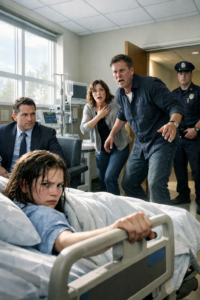
Hours later, a door opened and Dad’s voice hit the room like cold water.
“Where is she?” he demanded.
Footsteps approached, fast and angry, then stopped abruptly.
“You,” Dad said, and he sounded afraid.
I forced my eyes open. Dr. Smith was sitting beside my bed, hair damp, coat folded over her lap. She rose as my parents entered.
Dad’s hands were shaking—full, visible tremors he tried to hide by clenching his fists. “You can’t be here,” he said. “How did you—”
“Richard Sterling,” Dr. Smith said, using his first name like it was a diagnosis. “It’s been a long time.”
Mom looked between them, confused. Madison hovered near the doorway, unusually quiet, her face pale.
“You know him?” Mom asked.
“He was my student,” Dr. Smith said, eyes on Dad. “And he made choices back then that harmed other people. Choices he never owned.”
Dad swallowed hard. His hands shook harder. “This isn’t about that.”
“It’s about your daughter bleeding on the side of the road,” Dr. Smith replied. “And it will be reported.”
Mom’s voice cracked. “Reported? We didn’t—she left—”
“She was told to leave in a storm,” Dr. Smith said. “She said it at the scene. A nurse and I heard her. The paramedics heard her.”
Dad’s gaze snapped to me. “Olivia,” he said quickly, voice turning soft in that fake way it got when outsiders were watching. “Tell them you ran out. Tell them you’re—”
“No,” Dr. Smith cut in, stepping between him and my bed. “Do not ask her to protect you.”
A nurse appeared and told my parents visiting time was limited. Dad argued, but every time his eyes met Dr. Smith’s, his hands trembled like he couldn’t hold himself together. Madison stayed silent, staring at the floor.
When they were ushered out, Dr. Smith returned to my bedside and pulled the chair close.
“Why are you doing this?” I croaked, throat raw.
She looked tired, rainwater still dark on her sleeves. “Because you shouldn’t be alone,” she said. “And because I recognize what it looks like when a child is made responsible for everyone else’s comfort.”
My eyes burned. “They believed her.”
“I know,” she said softly. “But you’re not going back there tonight. Or tomorrow. Not unless you want to.”
The sentence felt impossible, like a door opening in a wall I thought was solid.
“I’m fifteen,” I whispered. “I don’t get choices.”
“You do,” she said, voice steady. “I’ll make sure you do.”
Dr. Smith pulled the blanket higher over my shoulders and called a nurse back in to document everything—my injuries, my statement, the fact that I’d been turned out during a storm warning. I watched her move with calm authority, like the world actually had rules my family couldn’t bend. When she sat again, she didn’t fill the silence with advice. She just stayed, a steady presence in a room that smelled like antiseptic and second chances.
For the first time since the porch, I let myself breathe.
Part 3
The next morning, a social worker named Marisol came with a clipboard and a calm voice. She asked questions about home: discipline, safety, history. I answered carefully at first, then more honestly than I’d ever been allowed to be.
Dad returned with Mom that afternoon, looking exhausted but still angry. He insisted it was a misunderstanding, that I was dramatic, that I’d “run out.” Marisol didn’t flinch. She explained that an investigation was opened and I couldn’t be discharged into their care until an assessment was complete.
Dad’s mouth tightened. “She’s lying,” he said, and it sounded like he was trying to convince himself.
Dr. Smith stood beside my bed, posture straight. “I found her,” she said. “I heard what she said. I watched her lose consciousness. Whatever story you’ve been telling yourself, it ends here.”
Mom’s eyes filled. “Olivia, please,” she whispered. “Come home and we’ll talk.”
I looked at her and realized she hadn’t asked how much it hurt to breathe.
“I don’t feel safe,” I said.
The words made the room go still. Dad’s face reddened, then drained. Mom covered her mouth like she’d been slapped. Madison, who’d been lingering in the doorway, made a small sound—half scoff, half gasp—like she didn’t expect me to speak.
CPS offered options. Temporary placement while the case moved forward. Relatives, foster care, emergency housing. Dr. Smith’s name appeared on the list because she was already certified through a university program that supported teens in crisis.
“I’ll take her,” Dr. Smith said, simple and firm.
Three days later, I left the hospital with a brace around my ribs, stitches in my scalp, and a strange new feeling: I might survive this without crawling back.
Dr. Smith’s house sat behind tall maples at the edge of town. Inside, it smelled like peppermint tea and books. A golden retriever ambled up and pressed his head into my hand like he’d known me forever.
“Jasper,” Dr. Smith said, scratching his ears. “He’s convinced he can solve anything by leaning on people.”
She showed me a guest room with a quilt at the foot of the bed and a note on the nightstand in neat handwriting: You are safe here. Sleep.
I stared at that note until my eyes blurred.
The first weeks were a blur of caseworker visits and paperwork. Dr. Smith attended every meeting, never speaking over me, never letting anyone dismiss my words. She arranged for me to transfer schools to avoid gossip and to keep me away from my family’s orbit.
At night, I learned what it felt like to fall asleep without listening for anger in the hallway.
One evening, after a particularly hard meeting where Dad had tried to charm the caseworker and Mom had cried without saying anything real, I asked Dr. Smith the question that had been gnawing at me.
“Why did my dad react like that when he saw you?”
Dr. Smith washed dishes slowly, giving herself time. “Your father was brilliant in college,” she said. “And proud. When he got caught cheating on a major research project, he tried to blame me. When I refused to cover for him, he made sure people thought I’d targeted him. It cost me opportunities. It cost me peace.”
I stared. “So you hate him.”
Dr. Smith rinsed a plate and set it in the rack. “I don’t waste energy on hate,” she said. “But I don’t excuse harm either. And I won’t let him harm you again.”
In the quiet that followed, I realized something: the adults in my house had taught me truth was negotiable. Dr. Smith was teaching me it wasn’t.
Winter arrived. The court process moved slowly. My parents signed a temporary guardianship agreement rather than risk public scrutiny. They told relatives they were giving me space. Dr. Smith didn’t correct them. “Stability first,” she told me. “We can chase justice later if you want. Or not at all. Your life is the point.”
With my ribs mostly healed, I threw myself into school because learning was still my safest language. Dr. Smith encouraged it without turning it into pressure. She asked what I wanted to build, not what I wanted to prove.
One Saturday she came home with a box of parts—filters, tubing, a small pump—and set it on the kitchen table.
“I heard you built a filtration system when you were younger,” she said. “Build another one. Not for a ribbon. Just because it helps you remember who you are.”
We worked side by side, music low, Jasper snoring at our feet. When muddy water ran through the system and came out clear, I laughed—an actual laugh—and Dr. Smith clapped like I’d performed a miracle.
On my sixteenth birthday, she baked a crooked chocolate cake and put sixteen candles in it. She sang softly, like she didn’t want to scare me with celebration.
“Make a wish,” she said.
I looked at the flames and wished for something I’d never said out loud.
I wished to be wanted, without earning it through silence.
Part 4
By spring, Dr. Smith filed for permanent guardianship until I turned eighteen. The word permanent made my chest tighten—hope and fear tangled together. Hope felt dangerous after years of being punished for wanting.
My parents threatened to fight at first, mostly through angry voicemails that Dr. Smith saved without comment. Dad talked about “family reputation” and “discipline,” like my ribs had cracked themselves for attention. Then their tone shifted. They realized a court battle would put their choices under a spotlight. Dad cared about control, but he cared about appearances more.
The hearing took place in a beige courtroom that smelled like old paper. A caseworker sat behind us. My parents sat stiffly across the room; Madison sat behind them, eyes fixed on me like she was watching a game she expected to win.
Dad’s lawyer tried to paint me as unstable. “Teenagers can be dramatic,” he said, smiling thinly. “Olivia has always struggled with jealousy toward her sister.”
I almost laughed at the absurdity. Dr. Smith didn’t.
She stood when it was her turn, voice calm and surgical. “Olivia was left outside during an active storm warning,” she said. “She was struck by a car while trying to find shelter. Her injuries are documented. Her statement at the scene is documented. This is not teenage drama. It is neglect.”
Dad’s jaw worked like he was chewing rage. His hands trembled so badly he kept them clasped under the table. Madison stared at the floor.
The judge asked me what I wanted. My mouth went dry. I could feel my parents’ eyes on me, heavy with expectation.
“I want to stay where I am,” I said. “I want to finish school. I want to be safe.”
The judge nodded once, as if the case had always been that simple. “Then you will.”
When the ruling was read, Mom’s shoulders sagged. Dad’s face tightened, like he’d swallowed something bitter. Madison didn’t cry. She just sat very still, as if she was listening to a door lock that she hadn’t expected to hear.
Outside the courthouse, Mom tried to hug me. Her perfume was sweet and familiar, and it made my stomach flip. Dad stood behind her, jaw tight, hands trembling in his pockets. He wouldn’t look at Dr. Smith.
“We still love you,” Mom whispered, like love was a spell that could undo harm.
“If you loved me,” I said quietly, “you would have listened.”
I walked away before my knees could shake.
High school became something I endured and, strangely, enjoyed. Without Madison’s orbit, I joined science club, volunteered at a river cleanup, and learned what it felt like to raise my hand in class without wondering who would punish me for being visible. A guidance counselor asked about my parents for a scholarship form, and for the first time I said, “They’re not involved,” without apologizing.
My stormwater filtration project qualified for the state science fair. I placed first again. The ribbon didn’t feel like a replacement for my parents; it felt like proof that my life hadn’t ended on that porch. Dr. Smith took a photo of me holding the trophy and framed it next to a picture of her first graduating class.
That summer she took me to State University’s campus. She showed me the lab where she taught, the research posters on the walls, the students working late with coffee cups and tired eyes. She pointed out the river that cut through town and explained how stormwater carried everything into it—oil, trash, microplastics—unless someone designed systems to catch it.
“This could be you,” she said. “If you want it.”
For the first time, college didn’t feel like escape. It felt like a door I was allowed to open.
Senior year rushed by in a blur of applications and exams. Dr. Smith helped me fill out financial aid forms and wrote recommendation letters that described me like a whole person, not a problem. When acceptance letters arrived, State University offered the biggest package: full tuition, a research stipend, and a spot in the environmental engineering cohort.
Dr. Smith raised a glass of sparkling cider in her kitchen. “To you,” she said. “And to every storm you survived.”
On graduation day, I stood on stage as valedictorian and gave a short speech about resilience and curiosity. My voice didn’t shake. Dr. Smith sat in the front row, clapping like she could fill the empty seats where my parents should have been. Afterward, she handed me a small box. Inside was a blank blue ribbon, the kind you can buy at craft stores.
“It’s silly,” she admitted. “But I wanted you to have something you can write on yourself.”
I ran my thumb over the satin. “What should I write?”
“Whatever title you want for your life,” she said. “You don’t belong to anyone else’s story.”
The week before I left for college, I drove past my old house without meaning to. The porch light glowed. Curtains were drawn. Everything looked normal, like storms never happened there. I parked across the street, stared, and waited for grief to swallow me. It didn’t. What I felt was quieter.
It wasn’t my home anymore.
That night, I packed my dorm room boxes in Dr. Smith’s living room while Jasper watched like a supervisor. Dr. Smith sat beside me and said, “You don’t have to be fearless. You just have to keep going.” I drove to campus the next morning with my whole future in the trunk, and for once, the road ahead felt wide open.
Part 5
College was the first place where I wasn’t defined by Madison’s narrative. I was just Olivia: a little guarded, obsessed with data, and determined to build a future no one could take from me.
I joined Dr. Smith’s lab as a freshman. On campus, she was intimidating—sharp questions, high standards. With me, she was steady. She taught me how to argue with evidence instead of emotion, how to design experiments that answered real problems. When I rushed to apologize for a mistake in my first lab report, she waved it off.
“Fix it,” she said. “Learn from it. Don’t beg.”
“You can be angry,” she told me later. “Just don’t let anger be your only fuel.”
I found friends in my cohort—late-night study sessions, shared stress, laughter that felt uncomplicated. I learned to accept help without feeling like it came with strings. The first time someone offered to proofread my paper, I almost refused out of instinct. Then I remembered I wasn’t in my parents’ house anymore.
Sophomore year, I met Ethan in a hydrology class. He sat behind me, tapping his pencil like he was coding with it. After he gave a half-right answer in discussion, he caught up to me and said, “If I buy you coffee, will you explain why my brain can’t hold onto runoff equations?”
I should have said no. Independence had been my armor for years.
But I was tired of living like I had to be untouchable to be safe.
So I said yes.
Ethan didn’t treat my past like entertainment. When I told him pieces of it over time, he didn’t demand details or offer easy fixes. He just listened, squeezed my hand, and said, “I’m glad you lived.” That sentence became a quiet cornerstone in my life.
After my bachelor’s degree, I stayed for a master’s program in urban stormwater systems. The theme felt almost funny—storms again—but this time I was the one designing solutions instead of just surviving them. I spent nights in the lab testing filter media, mornings wading into retention ponds with sampling bottles, afternoons presenting results to city engineers who looked skeptical until the data cornered them.
My thesis turned into a prototype: a modular filtration insert for street drains, cheap enough to scale and effective enough to matter. It trapped microplastics and heavy metals before they reached rivers. A pilot program with the city became a contract. A contract became an investor meeting where my hands shook so badly I spilled water on the conference table.
Afterward I called Dr. Smith in a panic. “I blew it,” I said.
“You showed up,” she replied. “You spoke the truth. That’s the opposite of blowing it.”
ClearRun Systems started small—me, Ethan on weekends, and a borrowed garage. We installed units in alleys where nobody took pictures, in neighborhoods that flooded every year and were always last on the list for help. When the first storm of the season hit and the sensors showed pollutant levels dropping, I cried in my car, not from sadness but from the sheer relief of building something that worked.
By twenty-six, I had employees, deadlines, and meetings where people took my ideas seriously. Dr. Smith introduced me at conferences with pride she tried to mask. “This is Olivia Sterling,” she’d say. “One of the best minds I’ve had the honor to teach.”
Honor. Teach. Not burden. Not problem.
My parents were mostly absent. Once a year, Mom sent a card with a careful message about missing me. Dad never wrote. I didn’t respond. Contact felt like reopening a wound that had finally formed scar tissue.
Then, one day on campus, I saw Madison. She was older, wearing a State University sweatshirt like she belonged there. She froze when she saw me. I kept walking, heart hammering, refusing to give her the power of my attention.
A week later, an email landed in my inbox.
Subject: Please don’t delete this.
It was from Madison.
Olivia,
I saw your name on the commencement program. You’re the keynote speaker.
Mom and Dad don’t know. They still talk about you like you’re the problem. I can’t keep living with it.
I need to tell you the truth, and you deserve to hear it before you’re on that stage.
My breath caught. I’d agreed months earlier to be keynote speaker at State’s spring commencement—my alma mater, Dr. Smith’s quiet suggestion, a chance to tell graduating students that building a life is possible even when the foundation cracks. I hadn’t checked which graduates would be there. I hadn’t looked backward.
Now my past was asking for a meeting.
Ethan found me staring at the screen like it might explode. Dr. Smith arrived within an hour because I called her without thinking. She read the email, then looked at me.
“She might want to control the story,” I said.
“Or she might finally be drowning in it,” Dr. Smith replied. “Either way, you deserve clarity.”
Clarity sounded like clean water.
I typed back one line: Saturday. Noon. Campus café by the library.
Then I closed the laptop and felt my hands start to shake.
Part 6
The campus café was crowded with students cramming for finals, the air thick with espresso and stress. I chose a table in the corner where I could see the door. Ethan sat beside me. Dr. Smith sat across, calm and watchful.
Madison walked in five minutes late.
She looked different—less polished, more human. Her hair was cut shorter. Her shoulders were tense, like she expected the room to attack her. When she saw me, she stopped as if she’d run into glass.
“Olivia,” she said, voice thin.
I didn’t smile. “You said you wanted to tell me the truth.”
Madison swallowed hard and slid into the chair opposite me. Her hands twisted together until her knuckles went white.
“I lied,” she said. The words dropped heavy between us. “I lied about the money. The rumors. The notes. The storm night. All of it.”
Even hearing it out loud made my skin prickle. My heart was beating like I was fifteen again, standing in a hallway with rain on my hair.
“Why?” I asked.
She blinked fast. “Because you were always… you,” she said, frustration and shame tangled in her voice. “You were good at school. You didn’t even have to fight for it. And Mom and Dad treated me like I was fragile, but it never felt like love. It felt like a leash. If I cried, they came running. If I succeeded, they acted surprised. So I learned crying was power.”
“That doesn’t explain throwing me out,” I said.
“Jake was the trigger,” Madison whispered. “When he talked to you, I panicked. I wanted them to pick me. On purpose. I wanted you to lose for once.”
She inhaled shakily. “I used an app to send messages to myself. I copied your handwriting from your notebooks. I made fake accounts. I scratched my own arm with a safety pin and told Mom you grabbed me. I told them you said I should die.”
Ethan’s hand tightened around mine. Dr. Smith’s face stayed composed, but her eyes sharpened like a blade.
“And they believed you,” I said, voice flat.
Madison nodded, tears spilling. “They believed me without question,” she whispered. “Dad looked at you like he’d been waiting for a reason.”
“And when he opened the door?” I asked.
Her shoulders shook. “I didn’t stop it,” she said. “I watched. Part of me felt powerful, and then I hated myself for it.”
Silence stretched, filled only by the café’s low hum.
“I didn’t think he’d actually throw you out,” Madison rushed. “I thought he’d punish you. Ground you. Take your stuff. Like always. I thought you’d come back upstairs crying and it would prove you were guilty. I thought—”
“You thought you’d win,” I said.
Madison’s face crumpled. “Yes,” she admitted. “And then the police called and said you’d been hit by a car, and I thought you were dead. I thought I killed you.”
A flash of the hospital ceiling lights hit my mind. The beeping machine. Dad’s shaking hands.
“You never told them,” I said.
“I tried,” she whispered, and the word surprised me. “After you left the hospital, Mom kept saying you’d done it to us. Dad kept saying you were sick. They told everyone you ran away because you were unstable, and I—” She pressed her fingers to her mouth, swallowing a sob. “If I confessed, it would mean they were wrong and I was the monster. I couldn’t breathe either way.”
Dr. Smith finally spoke, voice measured. “Why now?”
Madison stared at the table. “Because I can’t breathe at all anymore,” she said. “Every congratulations feels like a lie. And because she’s the keynote speaker. Mom and Dad will clap for her without knowing who she is, and I’ll be trapped in the thing I made.”
She dug in her bag and pulled out an envelope, sealed. “I wrote it down,” she said, sliding it toward me. “Everything. The app name. The accounts. The safety pin. I even printed screenshots I saved back then because I was terrified someone would catch me, and I wanted proof I could control it.” Her voice broke. “You should have that proof, not me.”
I stared at the envelope like it was both oxygen and poison.
“What do you want?” I asked.
Madison’s voice shook. “I want to tell them myself,” she said. “Before you go on stage. I want to stop hiding. I know I don’t deserve mercy, but… I’m asking.”
Anger rose, hot and familiar. Then exhaustion followed, heavier. Thirteen years of unanswered questions had been a weight I carried even when I pretended I didn’t.
“I will not protect you,” I said.
Madison nodded quickly. “I don’t want you to,” she whispered. “I want you free.”
I picked up the envelope. The paper felt thin, but the years inside it felt heavy.
“Tell them by Monday,” I said. “Before rehearsal. If you don’t, I will.”
Madison nodded again, eyes wet. “I will,” she promised.
When we stood to leave, she whispered, “I’m sorry.”
I didn’t offer forgiveness. I only said, “Don’t lie again.”
Outside, spring air hit my face, warm and bright, and my hands were shaking—just like my father’s had in the hospital.
Part 7
Commencement week wrapped the campus in banners and chaos. Families arrived with flowers and cameras. Graduates practiced tossing caps. I rehearsed my speech in an empty lecture hall, the words bouncing off the walls like they belonged to someone braver.
Madison didn’t contact me.
By Wednesday night, my stomach was a hard knot. I opened the envelope she’d given me and read the confession in her handwriting—dates, details, the name of the messaging app, a description of the safety pin. There were printed screenshots too, ugly little receipts of cruelty. Seeing the proof didn’t heal me, but it did something important: it made the truth undeniable.
Ethan found me pacing our living room, papers spread across the table.
“She’s going to let them sit there and clap,” I said. “She’s going to let them keep believing I deserved it.”
Dr. Smith arrived with her usual calm, and when she saw the confession, her expression tightened. “Then you tell the truth,” she said. “Not to punish. To end it.”
The morning of commencement, the arena hummed with thousands of voices. I stood backstage while graduates filed in, their gowns swaying like dark waves. A staff member clipped a microphone pack to my robe and asked if I was ready.
I wasn’t. But I nodded anyway.
Through a gap in the curtain, I saw the front rows. And there they were—my parents.
Mom sat with her hands folded, eyes shining with pride meant for Madison. Dad sat stiffly beside her, suit pressed, face older. His fingers tapped his knee in a nervous rhythm. Madison sat on Mom’s other side in her cap and gown, pale, staring straight ahead like she was bracing for impact.
As I watched, my father leaned toward my mother and said something I couldn’t hear. Mom shook her head, lips tight. Then Madison’s shoulders lifted with a shaky breath, and I saw her twist her hands in her lap—exactly the way she’d done in the café.
Dr. Smith placed a steadying hand between my shoulder blades. “Breathe,” she murmured. “No matter what they do, you are not fifteen anymore. You have choices now. You have people who stay.”
My name boomed through the speakers. “Please welcome our keynote speaker, Olivia Sterling.”
Applause rose. I stepped into the light. The stage lights were hot, and my fear didn’t care.
From the stage, the audience blurred into faces and color, but my eyes found my family like magnets. Mom smiled politely, not yet recognizing me from a distance. Dad’s mouth was a thin line. Madison’s eyes were glassy with fear.
I reached the podium, set my notes down, and looked out at the graduates.
“Congratulations,” I began. My voice came out clear, even when my hands wanted to tremble. “Today is about endings and beginnings. About walking out of one life and into another.”
I spoke about storms—real ones, the kind that flood streets and rattle windows. I talked about how storms reveal what’s sturdy and what isn’t, how they expose the weak seams in our systems and in ourselves.
Then I said, “When I was fifteen, I was told to leave my house in the middle of a storm. I walked out with nowhere to go.”
The arena quieted, the silence thick.
“I didn’t make it far,” I continued. “I was hit by a car. I woke up in a hospital with cracked ribs and stitches and one question: why didn’t anyone stop the door from closing?”
A murmur rippled through the crowd—shock, sympathy, disbelief.
“That night, someone did stop,” I said. “A stranger on the road found me and stayed. She wasn’t my family, but she became the reason I’m alive and standing here.”
I nodded toward Dr. Smith as she stood in the audience. The crowd applauded her, warm and loud.
In the front row, my father went pale.
His hands started to shake.
He stared at Dr. Smith like he’d seen a ghost. Mom turned to him, confused, then looked back at Dr. Smith and froze as recognition landed. Madison’s face crumpled.
I gripped the podium. Thirteen years pressed behind my ribs like a tide.
“Storms happen in families too,” I said. “Sometimes you grow up learning that the loudest person gets believed, and the quiet one gets blamed. Sometimes adults mistake control for love. Sometimes they accept the easiest story because the true one would require them to change.”
I inhaled, and the next words felt like stepping off a cliff.
“My name is Olivia Sterling,” I said. “And I was the daughter who was erased.”
Mom’s hand flew to her mouth. Dad went rigid, hands trembling harder, eyes wide with panic. Madison’s shoulders shook with a sob.
I looked straight at them from the stage, letting the truth stand where the lie had lived.
And Madison began to cry.
Part 8
At first I thought Madison would shrink into her seat and let me carry the moment alone. That was the pattern I’d lived under: she struck, I absorbed. But then she stood, shaking, and I realized she was choosing something different.
She turned to our parents, mouth moving, words lost in the distance. Mom’s face was wet with tears. Dad looked like he couldn’t decide whether to stand or vanish.
I leaned toward the microphone. “Truth is not optional,” I said softly, and the arena held its breath. “Not if you want a real beginning.”
Madison stepped into the aisle and hurried toward the stairs to the stage. A staff member moved to stop her, then hesitated when the dean looked at me for direction. I nodded once.
Madison climbed the steps in her cap and gown, face blotchy, eyes wide with terror. When she reached the podium, her hands shook so hard she had to grip the edge to steady herself.
“My name is Madison Sterling,” she said, voice raw. “I’m graduating today, and I… I have to say something.”
A ripple of confused murmurs moved through the crowd and then died.
Madison swallowed hard. “When I was twelve, I started lying about my sister,” she said. “I blamed her for things I did. I forged her handwriting. I used an app to send messages to myself. I scratched my own arm and told my parents she did it.”
A collective gasp swept the arena.
“She never bullied me,” Madison said, tears streaming. “She never told me to die. I said those things because I was jealous and selfish, and because I knew my parents would believe me.”
Mom made a strangled sound. Dad stood abruptly, knocking his program to the floor. His hands shook violently; he tried to clasp them together to hide it.
Madison turned toward them, voice breaking. “You believed me without question,” she whispered. “You threw her out in a storm.”
She looked back at the crowd. “Olivia was hit by a car. Dr. Eleanor Smith saved her. And I’ve lived with that for thirteen years.”
Her shoulders sagged as if the confession pulled something out of her body. “I’m sorry,” she said. “Olivia didn’t deserve it.”
She set the microphone down and stood there shaking, exposed.
The arena erupted into stunned murmurs. The dean stepped forward and announced a brief pause, trying to steady the room. Madison was guided offstage by staff, eyes fixed on me like she expected me to strike back.
I felt something loosen inside my chest—not forgiveness, not warmth, but relief. The lie was finally in the open air, where it couldn’t rot in silence anymore.
I finished my speech with the last scraps of my prepared notes, talking about accountability and the systems that fail people when they reward the easiest story instead of the true one. When I stepped away from the podium, the applause that rose wasn’t cheerful. It was heavy, respectful, complicated.
Backstage, someone offered a private conference room for “family matters.” My legs felt like water as I walked down the hallway with Dr. Smith beside me and Ethan a few steps behind.
Mom stood when I entered the room, sobbing. “Olivia,” she whispered, as if my name could undo thirteen years.
Dad stayed seated, head in his hands. His shoulders shook. When he looked up, his eyes were red, and his hands—still trembling—lifted toward me and then stopped in midair like he didn’t deserve contact.
“I’m sorry,” he rasped.
The apology didn’t fix anything. But it was real.
Madison sat near the wall, pale, staring at the floor. She looked smaller now that her armor was gone.
Mom reached for me. I stepped back gently. “Don’t,” I said. “Not like that.”
Mom’s sob turned into words. “We didn’t know,” she pleaded. “We didn’t know she was lying.”
“Yes, you did,” I said, and my voice wasn’t cruel. It was steady. “You knew she lied about other things. You just didn’t want to believe it because believing it meant you were wrong about how you treated me.”
Mom flinched. Dad’s jaw worked like he was trying not to break.
“I failed you,” Dad said, voice cracking. “I failed you as a father.”
“You did,” I replied. “Because you made the same choice over and over.”
Madison’s voice was small. “I’m sorry,” she whispered again.
“I believe you,” I said, turning to her. “But believing you doesn’t mean I trust you.”
She nodded, tears falling.
Dad looked at me like a man begging for instructions. “Tell me what to do,” he said. “I’ll do anything.”
“You can’t undo it,” I said. “But you can stop pretending it didn’t happen. You can get therapy. You can accept consequences. And you can accept that I may never come back the way you want.”
Mom sobbed harder. Dad nodded, trembling hands clasped together.
Dr. Smith stepped forward then, her voice calm but edged with steel. “You will not pressure her,” she told them. “You will not demand forgiveness as payment for apology. If you want any relationship with Olivia, you will earn it with consistency.”
Dad met her eyes, shame flooding his face. “Dr. Smith,” he whispered.
She answered with the same precision she’d used in the hospital. “Richard. You don’t get to rewrite the past. You only get to choose who you are now.”
The room went quiet, like the air after thunder.
When I walked out of that conference room, my chest felt strangely light. The storm had finally moved through.
Part 9
Rebuilding wasn’t dramatic. It was slow, awkward, and full of boundaries.
My parents started therapy because I made it a condition for any contact and because Dr. Smith refused to let them turn apology into performance. Dad resisted at first, defensive and stiff. Then, gradually, his pride gave way to exhaustion. Mom wrote letters—real ones this time—apologizing without excuses. I didn’t reply right away. Healing for me wasn’t something I owed anyone on a schedule.
Madison entered counseling too, required by the university after her public confession. She lost some friends when the story spread. People like clean narratives at graduation, not reminders that families can be ugly under the photos. But she also started doing the work she’d avoided as a kid: telling the truth even when it cost her.
When she asked to speak to me again, I waited weeks before answering. Not yet, I wrote. And that was honest.
Months later, Madison asked if she could send one more thing: the old phone she’d used to hide parts of the lie. I agreed, but only through Dr. Smith. The package arrived with a simple note—No excuses. When Ethan and I powered the phone on, I didn’t scroll through it like a detective. I didn’t need to punish myself with every detail. I just held it for a moment, feeling the weight of how easily a story can be forged, and then I sealed it in a box for my therapist to archive with the rest of my evidence. Closure, I learned, is sometimes choosing what not to reopen.
A year later, Madison and I met at a volunteer event for teens in foster care. She kept her distance and introduced me as “a mentor,” not “my sister,” letting me decide what I wanted to be. That small respect mattered more than any dramatic apology.
A year later, I met my parents in a public park on a bright fall afternoon. Leaves skittered across the path in little gusts. Dad’s hands shook when he lifted his coffee cup; he noticed and set it down, embarrassed.
“I’m not going to pretend we’re fine,” I said.
Dad nodded. “We’re not,” he admitted. “But I want to be better.”
Mom’s eyes filled. “We’re sorry,” she whispered, again and again, but now she didn’t add excuses.
I told them about my work—ClearRun Systems expanding into coastal cities, our filtration inserts being installed in neighborhoods that flooded every year. I told them about a grant we’d won to build green infrastructure in low-income areas, the kind of equity Dr. Smith had preached about long before I understood the word.
They listened like they were learning me from scratch. It didn’t erase the past, but it did something quieter: it made space for the truth to exist without a fight.
When I stood to leave, Dad asked, “Will you ever come home?”
“I have a home,” I said. “It’s just not that house.”
He swallowed, nodded, and didn’t argue. That, more than any apology, was progress.
Two years after commencement, Ethan and I married in Dr. Smith’s backyard under strings of lights. Jasper, older and grayer, insisted on lying in the aisle. Dr. Smith officiated because she’d gotten ordained online in a fit of amused rebellion.
My parents attended quietly, sitting in the back, respectful. Madison came too, hands folded, eyes nervous. She didn’t try to corner me. She simply whispered congratulations when I passed, and for the first time, I could hear sincerity without tasting bitterness.
When I became pregnant the following year, Dr. Smith cried without apology. “You’re going to be an incredible mother,” she told me. “Because you know what it is to be without safety, and you chose to create it anyway.”
Our daughter was born in October during a gentle rain that tapped the hospital window softly—nothing like the storm that had once tried to swallow me. Ethan held her while I watched her tiny chest rise and fall.
“What do you want to name her?” he asked.
I looked at Dr. Smith in the corner of the room, eyes shining, hands clasped like she was holding herself together.
“Eleanor,” I said.
Dr. Smith laughed and cried at the same time. “Oh, Olivia,” she whispered.
As Eleanor grew, Dr. Smith became “Grandma Ellie,” the kind of presence that made a child feel like the world was solid. My parents met their granddaughter carefully, respectfully, on my terms. Madison sent Eleanor a little science kit with a note: For the little engineer. Eleanor squealed and dragged it to the kitchen table, already asking how to make dirty water clean again.
The years softened some edges and sharpened others. I learned forgiveness isn’t a switch. It’s a boundary you adjust over time. I learned that love without accountability is just control wearing a softer face.
Dr. Smith retired at seventy and finally stepped away from lectures and grant deadlines. On her last day, former students crowded around her with thanks. When it was my turn to speak, I took the microphone and looked at her.
“You didn’t just save my body,” I said. “You saved my belief that I deserved a life. You gave me shelter, and then you handed me tools and said, Build.”
After the ceremony, rain began again—soft, steady. Eleanor ran up with an umbrella and held it over Dr. Smith like she was guarding treasure.
“Grandma Ellie, you’ll get wet,” she scolded.
Dr. Smith laughed. “Thank you, my love.”
That night, after Eleanor fell asleep, I stood on my porch and listened to the rain. It washed the street clean in a steady rhythm. My hair stayed dry. My door stayed open behind me, warm light spilling onto the steps.
I thought of fifteen-year-old me, soaked and shivering, convinced she’d been erased.
I whispered into the night, “You made it.”
And for the first time, the sound of rain didn’t hurt.